Leave a comment

Coming to Jesus in 3 important steps

Homily for 14th Sunday Year A Ordinary time

lift up your hands to GodWhen I was in the Philippines, I was talking to a nun-in-charge of the Home for the Aged Priests in the Archdiocese of Cebu. The nature of her work allowed her to meet many different priests from different places. She shared with me a wonderful story of a priest-exorcist who came to stay in that place one day. The story was that this priest was doing the ministry of exorcism to a certain person who was possessed by an evil spirit. This priest played the music ‘How lovely is your dwelling place O Lord’. Hearing that, apparently the evil spirit started to cry. It is an amazing thing for this priest because in his experience as an exorcist, evil spirits are so arrogant, full of pride, swearing, cursing, uttering terrible words. But hearing it crying, is unusual. So this priest asked ‘why did you cry?’ The spirit answered: It’s true that God’s dwelling place is so lovely, so beautiful. But I no longer have the chance to live there. But you people just take this and many other things for granted.’
Friends, I’m sharing this with you because in our gospel today, Jesus is giving us a chance, an opportunity, an invitation, whoever we are, to come to him, to rest in him and to learn from him.  And this is too good an opportunity to miss and to be taken for granted. This is an invitation that assures us that not only that we can tell God, how great our problem is, but also that can we can tell our problems, how great our God is.

And I thank all of you, especially the young people here for responding to this invitation of Jesus- to come to him- through this Holy Eucharist. At times, we may be tempted to think Mass is dull, boring, repetitive, and we don’t get anything out of it. But St John Vianney would say: “If we really understood the Mass, we would die of joy.”  The Second Vatican Council Document in its Constitution on the Church ‘Lumen gentium’ put it even more beautifully saying that the ‘Eucharist is the source and the summit of Christian life.’ (LG 11). The Eucharist gives us life and keeps us alive. Scott Hahn, a protestant-turned-Catholic theologian recalled his amazement of the first time he’d been to Catholic Mass. While sitting in the Church, during the Liturgy of the Word, Hahn exclaimed: “I sat there saying ‘Man, stop the show, let me explain your prayers. That’s Zechariah; that’s Ezekiel. Wow! It’s like the Bible coming to life and dancing out on the center stage and saying, “This is where I belong.(http://www.catholiceducation.org/articles/apologetics/ap0088.html). One more thing, is that every time we receive the Eucharist, we not only come to Jesus, but we allow him to come into our lives and become part of us.

It is important to remember too that ‘coming to Jesus and resting in him’ is not only about our partaking in the Eucharist.

Coming to Jesus at Mass also means coming to celebrate as a community of faith.In the Church there is no DIY or ‘do it yourself’ Christianity, there are no ‘free agents’ as Pope Francis would say on  one of his Wednesday audiences at St Peter’s Square.  [See: http://w2.vatican.va/content/francesco/en/audiences/2014/documents/papa-francesco_20140625_udienza-generale.html]

The pope added: “We are able to live this journey (this faith journey) not only because of others, but together with others.” Pope Francis also acknowledges that it is a challenge for us to take because according to him: ‘It is true that walking together is challenging, and at times can be tiring: it can happen that some brother or some sister creates difficulties, or shocks us…. But the Lord entrusted his message of salvation to a few human beings, to us all, to a few witnesses; and it is in our brothers and in our sisters, with their gifts and limitations, that he comes to meet us and make himself known. And this is what it means to belong to the Church. Remember this well: to be Christian means belonging to the Church. The first name is “Christian”, the last name is “belonging to the Church”.

Coming to Jesus also means coming to him in faith.It is a challenge for us today because of the many things that would distract us from God, from the faith. There are people today, even in our immediate surroundings who would say to us ‘that they don’t need God’, and even showing pride of their not having faith at all. Francis Chan  puts it rather cleverly when he wrote: “The irony is that while God doesn’t need us but still wants us, we desperately need God but don’t really want Him most of the time.

If only all of us realize the beauty of our God and the value of our faith, we come to appreciate more of the gift of life that God has given us so generously. The other day, I visited  a parishioner who had been diagnosed of brain tumour and given few weeks to live. Her faith and her readiness to die amazed me. She couldn’t wait to get there. Her faith keeps her strong, and not feeling depressed by her situation. She realized ‘life is a gift’ and her faith tells her to continue living it no matter what it brings her. And that my friends, is true faith in action.  

This morning I was driving towards Raywood ( a small country Church) to say Mass there. It was foggy almost all of the way. The fog was so thick I could only see no farther than 50 metres ahead of me. So I had to slow down, turned my lights on, and more importantly, stayed on my lane. And I got there safely. That made me reflect though that at times, our faith is like that. Our faith at times could only help us see as much. There might be cloud of doubts or uncertainties, worries, or problems so thick that we could hardly see any light or any way out. But if we slow down (humble ourselves and pray, seek God’s face and turn from our wicked ways [cf 2 Chronicles 7:14]) , go to retreats, give time to ourselves and  to God), turned our lights on (keep on living, live in hope), stay on the right lane (remain in the Church), and keep going, then we’ll get to our final destination in the end (heaven and eternal life).

Friends, dear brother and sisters,  Jesus in the gospel is calling us to come to him, to take up his yoke with love and fidelity in him, and learn from his example of loving with no condition, of serving one another with no limits, and laying down our lives for our brothers and sisters. He is giving us an opportunity to come to  him in the Eucharist, to celebrate our faith as a Church, and he has gifted us the faith. These are our chances. And  I hope and pray, we wont take these amazing opportunities for granted. Otherwise, like the evil spirit in the story above, we would end up crying for ever rather than enjoying our lives in  happiness forever with God. Amen.


Leave a comment

God- the greatest of all risk-takers

Homily for Passion Sunday 2014

the-love-of-god-tara-ellisYesterday, I watched the movie ‘The Railway Man’ to support a fund-raising effort for the Philippines. Many of you might have seen it already but for me, that was the first time, and I would say it’s worth watching not only because its aim was to help some people in the Philippines, but because of its amazing  story line (based on a true story of course), a story of what love and forgiveness can do. For the benefit of those who haven’t seen this film yet, I would recommend you watch it.

It was a story of a British Army officer, who was one of the prisoners of war by the Japanese forces during the Second World War. One day, he was discovered to be the main culprit in making a radio from which he and the other prisoners learned what was going on with the rest of the world during the war. Because of that he had to bear a terrible and unimaginable torture by the Japanese soldiers. He survived though, got married, but the trauma of war lingered within him. Then when he learned that one of those  who tortured him was still alive, he went to search him to seek revenge. He found the man but instead of revenge, he forgave him. They became great friends until they both died few years ago.

I’m sharing this beautiful and true story of love and forgiveness with you because we are just getting into Holy Week- and like the story I just shared with you, the drama of Holy Week is also about love and forgiveness- love of God for us and forgiveness for all our sins by dying on the cross for us.

‘Love is the greatest of all risks’ says Jean Vanier, and this is really true of God. He loves us so much that he would take all risks even death itself just to express his love for us. This is what we are encouraged to reflect on this  Holy week. Yes, holy week is an opportune time for us to re-call and to pay more attention on our God who in and through Jesus, showed us how seriously in love He is with us.

Such is God’s love for us, that no matter how small or insignificant we think we are, God still cares for us and makes us a big part in the real drama of our salvation just as Jesus asked ‘So-and-So’ (i.e. nameless, faceless, or seemingly insignificant in the society) to use the latter’s upper room  for his last supper with his disciples. Such is his love for us that he left us a living and a life-giving memory of him through the Holy Eucharist. Such is God’s love for us, that despite we deny, disown him in public or even betray him for money, as Peter and Judas Iscariot did, he would still look at us with loving gaze and give us opportunity to repent. Such is his love for us that he wouldn’t turn his cheek away even if mocked, spat upon, slapped, being shamed or humiliated, or even crowned with thorns all because he wants to forgive us and he wants to save us from all shame that our sins bring us. Such is his love for us that though he is suffering himself, he is still one with us in our sufferings too just as he expressed his concern to and sadness for the women in Jerusalem. Such is his love for us that he embraced death, he willed to die because only through his death on the cross that we can have life. He lay down his life not only because we are his friends but because he wants to give life for his friends.

However, holy week is not just a reflection on God’s love for us and his forgiveness. It is also a time to express our response to God’s love for us. We can do this by solemnly and actively participating in our Holy Week and Easter liturgies and ceremonies, doing works of charity, reaching out to others in need, prayer and fasting, going to the sacrament of penance and reconciliation, being an instrument of God’s love and forgiveness ourselves in whatever way, form and capacity.

Because of love, God has taken all risks for us. We can see this quite clearly if we just stop what we normally do with our days, put an end to whatever bad habits or bad deeds we may be accustomed to be doing, drop whatever unnecessary baggage, concerns or worries we may have at the foot of the cross, and look up to the Cross of Jesus. ‘When we stand before Jesus crucified’, Pope Francis wrote in his  Apostolic Exhortation Evangelii gaudium, ‘we see the depth of his love which exalts and sustains us, but at the same time, unless we are blind, we begin to realize that Jesus’ gaze, burning with love, expands to embrace all his people.’ And there is more we can realize when we stand before the Cross of Jesus, the Pope continues. ‘We realize once more that he wants to make use of us to draw close to his beloved people. He takes us from the midst of his people and he sends us to his people…’ (EG # 268). In other words, by putting ourselves before the Cross and contemplating on Jesus on the cross, we come to understand our real identity as Christians as well as we come to know our Christian mission.

Jesus takes the greatest of all risks for us in love, are we willing to take risks too for our loving God?

Let this be a point for our reflection as we enter into Holy Week.


Leave a comment

Friendship with Jesus: A Way to Life

Homily for fifth Sunday of Lent 2014

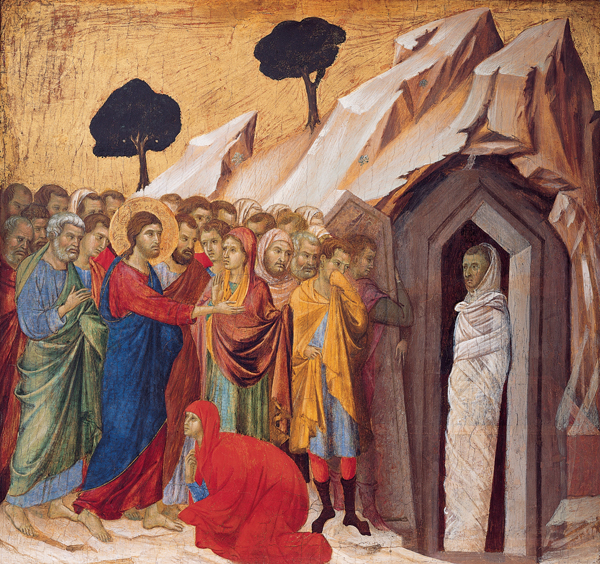
lazarusFew months ago, my youngest brother (who had just graduated from High School last week) told me that he wanted to become a priest like me. Hearing that, I was so excited about him, so I asked him to take the entrance exam for the seminary. He did, and I heard he passed the exam. But then last week, after his graduation ceremony he wrote to me a long message on Facebook, and he sent it to me many times. He might have pressed enter many times to make sure the message would get to me. He apologized to me saying that he is having second thoughts on entering the seminary, because he now wanted to take another course instead. I was a bit disappointed to be honest. But he wrote in his message something that I couldn’t believe my 18 year old brother would say. He said: ‘I realized that you don’t have to be a priest to be closer to God.’ Then he added: ‘Even a person who has no education can still get closer to God if he wants to.’ I thought: ‘Wow!  That’s a profound realization! He’s now speaking like a priest.

I’m sharing this with you because it is true that God doesn’t look at our transcript of records, or our diplomas, or the titles we have before our names, to consider us as his friends and to make us holy.

His offer of friendship is open for all, rich or poor, young and old, male or female. And the good news about being a friend of Jesus is that we can be assured for of being guided on the way towards holiness and towards eternal life.

On this 5th Sunday of Lent, Jesus is inviting us to accept his friend request. If we accept his request of friendship, we would never be disappointed.

Our gospel today is a wonderful testimony for us on what this friendship with God in Jesus means for him and for us.

As a friend, Jesus would face all risks just to show us how much  he loved us and cared for us as his friends. We could see this quite clearly in his friendship with Mary and Martha and Lazarus as we heard  in the gospel.

As the gospel tells us, Jesus loved them (cf Jn 11:5). As his friends, Mary and Martha sent a message to Jesus updating him of their brother’s ill-health. But this time too, Jesus could no longer get out in public so freely. Some people threatened to stone  him to death (cf Jn 11:8) because they couldn’t take the truth of who he was and what he was standing for.

But when Lazarus died, Jesus took the risk of appearing in public again, despite death threats he received. Because of his great love for his friends, he decided to go and be with his friends in their grief and also to show them what he has to offer them as gesture of friendship and solidarity in times of grief. For the disciples, for Thomas anyway, that was a suicidal move by Jesus, so to speak. So we heard the doubting Thomas here saying: ‘Let us also go, that we may die with him.’ (cf Jn 11:16).

Jesus wasn’t shy of showing how much he loved his friends especially Lazarus. One way and it is the only instance in the gospel a specific mention of Jesus weeping. Jesus felt the pain and sadness of the death of a close friend.

This is a great source of consolation for us, because this goes to show that God is with us in our sorrows, in our grief, in our disappointments and frustrations. This shows us that God is not indifferent to our pains and to our sorrows. He is our friend, one with us, accompanying us, staying close to us all the time.

Being our friend too, Jesus can be our great confidante. We can express ourselves completely and honestly to him. We can even vent out our frustrations to him. This is one thing that reminds me of the late Bishop Joe Grech. In our informal audience with him, he would often say to us then- seminarians words to this effect: ‘In your prayer, you can even get angry with God, as long as you don’t leave him behind.’ It is alright to express our hurts and pains to Jesus, even those pains, hurts and disappointments we feel to have been inflicted by God himself. We must never be afraid of expressing our deepest feelings to our God. He wouldn’t argue. He just listened and the do something about it. The sisters Mary and Martha in the gospel were in a way  venting  out their disappointment to Jesus. When Lazarus fell ill, the sisters sent a message to Jesus notifying him of what happened. They must have expected him to come at once and cure their brother. But he didn’t. We can only imagine their frustrations and disappointments when they said it not only once but twice, right in the face of Jesus: ‘If you had been here, my brother would not have died.’ The sisters were true to themselves before Jesus, so Jesus allowed them to witness first-hand one of the greatest miracles recorded in the gospel: raising the four-day old dead person back to life.

However, just like any other friendship, in order for our friendship with God to develop and grow into  a real and a personal one, the relationship should be mutual. We just can’t leave God do everything for us. We also need to do our bit. St Augustine said put it rightly: “God who created us without us, cannot save us without us.” In other words, we can’t just sit doing nothing waiting for God to extend his hands of friendship and salvation for us, without us extending our hands to receive his offer. He doesn’t force us, he only invites us. He doesn’t drive us towards him against our will, he only draws us to him with due respect to our freedom and freewill.  

This is one reason why Jesus asked the people around him at the site where Lazarus was buried to ‘remove the stone away’ themselves. If he could raise the dead back to life, he could easily move the stone away without lifting a finger. But he asked some help to remove the stone to symbolize that our active role in the story of our salvation. We have the duty to remove the stone away- the stone of selfishness and indifference.

Another way to grow into real friendship with Jesus is to keep in touch with Jesus always in prayer. The sisters did this, they sent a message to Jesus updating him of their brother’s situation. And because of that personal communication with Jesus, Jesus was moved to do something about it. He went to console them. And he even raised their dead brother back to life. He revived their hopes that have started to fade.

One more way to grow in friendship with Jesus is to help the modern ‘Lazarus’ in our midst today. We have the people who are bound by despair and hopelessness. We need to share with them the hope that we have through the resurrection of Jesus. We also have people whose lives are blocked by the huge stone of addiction, obsessions, or of any other forms of enslavement. We must help them find a way out, in our own way, in our own capability and capacity.

As we continue our Lenten journey, let us reflect on this passage from the gospel of St John: “Greater love has no one than this: to lay down one’s life for one’s friends.” (Jn 15:13).

As our friend, Jesus lay down his life for us. As his friends, are we also willing and ready to lay down our life for Christ?

Leave a comment

Looking through the eyes of God

Homily for 4th Sunday of Lent 2014

healing of the blind manA week before World Youth Day in Sydney in 2008, a group of German pilgrims from Paderborn were staying in Bendigo as part of their experience in Australia.  One morning, part of the pilgrim’s activity was to work with the pilgrims from Bendigo and do some volunteering works at St Vincent de Paul. So I was there with some of those German pilgrims and with me was a young man with autism. (Don’t worry, I’ve got the copyright from the person concerned to mention him in my homily today). While at St Vinnies sorting out linens, clothes, and all sort of stuff, though I don’t like eavesdropping but I heard two German pilgrims talking about the person with autism there. They were  saying something not good or making not-so-good comments about him. I pulled them aside and said to them: ‘You know what, you might not believe in this. Be careful what you say about that young man.  At the moment, he is studying in the University, taking on a degree on Graphic designs. Not only that, this year, he has just been awarded as the “City of Greater Bendigo Young Citizen of the Year Award.’ That caught the German pilgrims with surprise and utter disbelief.  And if I would have the chance to talk with those German pilgrims again, I would really tell them with pride: That he (the person they were talking about negatively) is doing very well in life, sharing his amazing talents and capabilities, travelling around the country giving talks and promoting awareness of Autism.

I’m sharing this with you not because I wanted to stand up as a hero for that particular person. He doesn’t need one because He already is. I am sharing this with you because sometimes in our life we get caught up with the appearance of someone or on the physical disability of a particular person or to any form of disability for that matter.

The disciples of Jesus were even caught up with the appearance of a person as we have heard in our gospel today. They can’t help but ask Jesus: ‘Rabbi, who sinned, this man or  his parents, for him to have been born blind?’ In saying this, the disciples had started putting up wall between them and the blind man- the wall that says: ‘Because you are a person  with disability, you are a sinner, and because I am perfectly normal, then I am a saint.’

But Jesus stood up for the man. He immediately toppled down the wall that comes between his disciples and the blind man. And he did it beautifully by letting them see the inner beauty and dignity of the human person, despite his/her disability. This is what he said: ‘Neither he, nor his parents sinned. He was born blind so that the works of God might be displayed in him.’

This is the beauty of our God. He creates us as an extension of his creative power. And for him we are all beautiful. For him, what’s in our heart is more important than how we look. We could see this same God in our First Reading (1 Sam 16:1, 6-7, 10-13) today telling Samuel (as he auditioned the sons of Jesse of Bethlehem for the position of being the King of Israel) ‘Take no notice of his appearance or his height…God does not see as man sees…man looks at appearance but the Lord looks at the heart.’

On this fourth Sunday of Lent, it is our mission to see others through the eyes of God. We can do this through Christ, who is the light of the world, the one who transforms the darkness of our life into light- and thus making us ‘children of the light’ (cf Eph 5:8-14).

So we need to take  Christ be the light of our lives in order to see others through the eyes of God. How?

First, like the blind man, we need to open ourselves totally to God and let him touch our lives. This means we open our hearts for God to touch us personally. The beauty about letting God be our personal friend and God is that we become courageous to stand up for him despite criticisms, despite people discrediting our claims, despite all odds we may have to overcome. This is the experience of the blind man. Jesus touched him personally (making a paste with a spittle). And because of that personal touch, his life was changed for the better.

Second is, we need to obey what Jesus tells us to do. The blind man went to the pool of Siloam when Jesus told him to, and then he was cured. The miracle of healing happened only when the man went and did what Jesus told him to do. This leads us back to the miracle at Cana in Galilee. Jesus said to the servants to ‘fill the jars with water’ which they did, and because of that they were privileged to have witnessed the very first miracle that Jesus did- changing water into wine. This also calls to obey the greatest of the commandment that Jesus asked of us: to love God and to love our neighbour as ourselves.

Third way to see others through the eyes of God is to balance our lives with a sense of humour. This doesn’t mean we just take life lightly, or taking life as a joke, rather this means we need also to look at the light side of life, or looking at ‘the bright side of life’.  We know that there are always people who  want or try to discredit us, or look down at us. The disciples, the leaders of the Jews, the Jews themselves, the parents of the blindman were trying to question his personal encounter with the Lord. But  the ex-blind man, stood up on his ground with a sense of humour. When the Jews turned to parents of the man asking about his cure from blindness, the parents told them: ‘He is old enough: let him speak for himself.’ They sure knew how to get out of the complicated situation aren’t they? I like the ex-blind man’s attitude over the situation when facing the seriousness of  the Jewish leaders. When the Jews accused Jesus as the sinner, or being not from God because he worked during the Sabbath making a paste with his spittle for 30 seconds maybe…and that’s hard work for the Pharisees, the ex-blind man just said to them: ‘I don’t know if he is a sinner: I only know that I was blind and now I can see.’ In a way, he’s saying ‘I don’t care if he is a sinner or not. All I care is that I can now see and you can’t stop me from seeing things.’  Then he added: ‘I have told you once and you wouldn’t listen. Why do you want to hear it again? Do you want to become his disciples too?’

As we keep up with our observance of Lenten season, let us reflect on this: God made us the way we are to be the reflections of his  mighty and beautiful works. The example of that person with austism I mentioned above is just one of the many proofs to this truth. Looking at our lives now: Are we showing that inner beauty of God in us or are we covering it up with our selfishness, insensitivity and indifference to the plight of others?