
Transfiguration: Moment of Grace
Homily for 2nd Sunday of Lent 2014 (year A)
 Prior to my ordination to the priesthood, I had to write a 25- thousand word ‘synthesis’ of the Catholic faith or a 25,000- word summary of the faith. Then when I finished writing that very long summary I should say, I had to sit down in front of the panel of theologians to make sure I got the theology right or have I written a sound understanding of the Christian faith. It was a nerve-wracking exercise I tell you.

I could still remember praying before the exam that the panel would only be consisting those theologians whom I liked, and who are more ‘merciful’ than the others. By God’s grace, one of the panelists was a Mercy nun and of course she is merciful to me. But to my disappointment the other panelist was the very person I was praying not to be in the panel, because of his reputation to complicate things, to confuse us all the more, or just to find a flaw in what we are saying so I was told. Anyhow, with no say to the matter, I just offered a silent prayer: ‘Lord, help me, I’m not expecting to get a credit or a distinction, just let me pass.’ That was my prayer as I sat for the exam with trembling knees and heart beating so fast.
To cut the story short I passed the exam and got a distinction. It was amazing but what amazed me all the more is that the questions they were asking were more or less the same points that I had looked at and studied about the night before. It was by sheer coincidence I thought, and I was really thankful to God for it. But then I was convinced later on: It wasn’t coincidence, it’s only God working anonymously.
I was so happy and proud of myself then because I wasn’t expecting to get more than pass. I felt like floating in the air as I walked out of the building, smiling, and if ‘selfies’ were popular then I would have taken a selfie with my very big smile on my face. Such was my joy that I was hoping that that feeling of ‘light’ and ‘happiness’ would never end. I just wanted to remain there. I just wanted to stay up there in that graced moment.
I’m sharing my personal graced moment with you because our gospel in this Second Sunday of Lent is also about ‘graced moment’ wherein the disciples Peter, James and John have the privilege to witness the transfiguration of Jesus. They had a foretaste of Jesus’ glory, a glimpse of his divinity and they also heard the voice from heaven saying: ‘This is my beloved Son,’ they have seen Moses and Elijah- the Old Testament figures whom they only knew of from the Scriptures. That was such a moment of light and happiness that Peter could only hope it wouldn’t finish as evident in his proposal to pitch three tents for Jesus, for Moses and Elijah. He just seemed not to care anymore about the mountain of transfiguration, the mountain of glory. Well, typical human experience indeed.
Certainly in our lives, we have had graced moments- ‘happy moments’, ‘light moments’ that we don’t create, we don’t expect, we don’t intend. And that is God’s grace. In moments like this, we could utter: ‘I hope this would never end or I hope I am always like this.’ However, human experience would teach us, this is never the case. Light moments fade, happy moments would later on get clouded with worries and anxieties.
However, moments of grace are not just significant moments to be left as an experience that would come and go. Rather, we need to reflect deeper on those moments because God is speaking to us more personally and more intimately through those graced moments. And to listen to God in those moments of grace we need to cooperate with God’s grace.
How can we cooperate with God’s grace?
We can make an analogy of ‘grace’ as the sun. We have the option not to stay under the sun and enjoy its benefits for us, by hiding in the dark. But that doesn’t mean the sun stops shining. It’s always there. But to enjoy it, we need to get out from our dark hiding place to enjoy the light and to let the energy from the sun penetrate into our bodies. Applying this to grace, then we need to get out and let ourselves be enveloped by God’s grace. And for us to experience this we need to walk closer with Jesus Christ and let him be our friend because He is God’s grace for us. He can also be understood as grace in a sense that He is God’s Riches At Christ’s Expense or as St Paul wrote that in him we receive the gift of God which is eternal life (cf Rom 6:23).
To cooperate with God’s grace: One, we need to walk closer to Jesus and follow his lead. This means we allow God to get behind the wheel in the car of life. We need to come up with Jesus to the mountain. This is not just an invitation for Peter, James and John, but it is an invitation for all of us to have a ‘retreat’ of sort with Jesus. We need to have time for God and with God, especially this season of Lent. This is also a call to prayer, a call to friendship with God, a call to be true to ourselves and be personal with our God. (Prayer)
Two, we have to come down with Jesus from the mountain of glory and face the cross. This is a call to get out of our comfort zones and reach out to others who don’t have the comfort we are experiencing. This is also call to be courageous for our faith, a call to stand up for Jesus till the end. This is call to deny ourselves, to take up our cross and follow Jesus. (self-denial). This is a call echoes by St Paul to Timothy in our Second Reading today, to bear hardships for the sake of the gospel. This is challenging because there is a saying that goes: ‘Jesus is too liberal for the conservatives and too conservative for the liberals.’ And more: ‘He may be comfort to the afflicted, he also afflicts the comfortable.’ Yet, we still have to follow Jesus carrying our crosses because in Him we know, we can have rest. In fact, we need to be thankful to Jesus because He changed the meaning of the cross for us. In him the cross is not the end but only the gateway to the resurrection, to eternal glory, to eternal life.
Three, we need to listen to Jesus calling us to live a life of humility. St Benedict is clear on this, when he said: ‘Humility is the ladder to heaven.’ This call to humility is one reason why Jesus strictly told his disciples ‘not to tell anyone what they had witnessed until the resurrection takes place.’ Jesus warns this because He doesn’t want that his disciples would think some are more privileged than the others. Can you imagine if Peter, James and John told everyone, the rest of the disciples might be jealous and say: ‘Why didn’t we have that privilege? It’s unfair? Are we not your closest disciples?’ One commentary on this passage says that Jesus didn’t want the disciples tell the experience to others is that they might lead to believe they are more superior than the others, because they had experienced something the others have not, and that might lead them to self-indulgence. By telling them strictly until the resurrection takes place, Jesus is teaching them to be more sensitive to others, to be more careful and prudent in their relationship with one another. So in a way, by keeping the secret for themselves they are meant to be empowered, motivated, strengthened and be courageous to follow Jesus and to proclaim his gospel of love, mercy, forgiveness to all.
As we step up on to the second week of Lent, let us reflect on our graced moments. What is God’s message for us to be and to do through those moments of grace?
How are we cooperating with God’s grace? Let this be a point of our reflection on this Second week of Lent.
The Temptation of Christ
Homily for 1st Sunday of Lent 2014
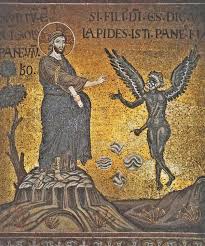 One of the things we do in Melbourne seminary while in formation is to gather into smaller groups every Sunday evening after dinner, to reflect and share about the words in the scriptures. One evening, the gospel being read was the gospel today which is about the temptation of Jesus. Obviously the topic for sharing was about temptation and how to overcome it. An older seminarian, now a priest said in the words to this effect: ‘I think a way to overcome temptation is to give in to temptations and then after we’ve given in, then we no more have temptations. So no more worries.’
I knew that seminarian was joking of course but that kept me thinking though. I thought, giving into temptation could really work if and only if temptation comes only once. Yet, we know through our experiences that temptations come in many ways and in many different forms. There is a temptation to be self- centred or selfish and we know we are giving in to this when we think only of ourselves or when we exploit others for our personal gain and glory. There is also a temptation to be self-righteous and when we are judgmental towards others or think of ourselves as superior to others, then we are giving in to the temptation to be self-indulgent.
There is good news for us though. Temptation in itself is not a sin. Jesus himself was tempted as we heard in the gospel today. What makes temptation a sin is when we succumbed to it, when we give in to it.
And there is even much better news for us. We have the power, the capacity to overcome temptation- not just something in us but someone who according to the Letter to the Hebrews: One who able to empathize with our weaknesses, one “who has been tempted in every way, just as we are–yet he did not sin.” (cf Heb 4:15 NIV). It is Jesus Christ our Lord.
So we heard in our gospel today an account of how Jesus was tempted and how he overcame all temptations of power, fame, and glory. Being a Christian does not give us immunity from temptations so as followers of Christ, we are to learn from Him, imitate his ways of overcoming temptations.
First, Jesus knew the scriptures by heart and so are we. Knowing the scriptures by heart doesn’t mean memorizing the Bible word for word, but rather it means ‘personalizing the word’ to borrow the phrase of Pope Francis in his Apostolic Exhortation Evangelii gaudium (EG 149). To explain this Pope Francis quoted the late Pope John Paul II’s Exhortation ‘I will give you shepherds’ (Pastores dabo vobis), and this means developing a ‘great personal familiarity with the word of God…[and] to approach the word with a docile and prayerful heart so that it may deeply penetrate [our] thoughts and feelings and bring about a new outlook in [us].’ By personalizing the Word, we become not only knowledgeable of the Word of God but also servants or doers of the Word. This differentiates us from the devil, the tempter who (as can be reflected on the gospel) also knew the Scriptures but not as servant of the Word because he was only using or manipulating the Word of God for his own personal gain and glory.
Moreover, we need to understand the scriptures and take it to heart because it is the Word of God, the ‘word of God [which] is alive and active. Sharper than any double-edged sword, it penetrates even to dividing soul and spirit, joints and marrow; it judges the thoughts and attitudes of the heart.’ (Heb 4:12). Furthermore, by knowing and understanding the Scriptures by heart, we come to know God better, and grow in a more real and personal relationship with Him. Also through understanding the Word of God in the Scriptures we come to encounter Jesus, our Lord and Savior.
The second way Jesus overcame temptation is to go beyond our material needs and strive for the good of our soul- to strive for holiness. This doesn’t mean that we can just neglect our basic needs. This means however that we look up to God, trust in him, and even be dependent on Him. This is a big challenge for those who are living a luxurious life, those who have got everything they think they need, those who can easily get the things that they want at the press of a button. Jesus would say: “Man does not leave on bread alone, but also on the word of God.” This means no amount of material gain or material possessions can really make us absolutely happy, or absolutely self-sufficient. This goes to show that no matter how much we deny God, or set him aside or not give him role to play in our lives, we still need Him. Thus, we are to strive for holiness- the holiness which ‘consists in not trying to get God to do our will but in trying to get ourselves to do God’s will’, as Fr Flor McCarthy a Salesian priest put it rightly.
A call to be holy is a big call because we can’t become holy overnight. We need faith, we need hope, we need a lot of patience, and it is hard work to be holy in fact, we can’t be holy on our own, we need God’s grace. Yet, this takes time and it definitely is a test of our perseverance. And we can learn from Jesus on how he handled the temptation to take matters into his own hand immediately. After 40 days of fasting, he was hungry, and the tempter came to him and offered him a quick-fix or a fast-food to appease his hunger by turning stones into scones. To overcome that temptation Jesus made the point that it is not good relying only on our skills, power, abilities and capabilities without God in our lives.
The third way to overcome temptation is to stand on our ground by having Christ as our foundation. This means we are to be convinced and be courageous as a follower of Christ. This also means we have to be that dedicated and committed to our mission as people of God and as people with God in the world today. Jesus in the gospel knew his mission so well. He was sent by the Father to show the Father’s love, forgiveness, care and concern for everyone. That mission is so real and strong in him that he would face everything just to carry it out, even death. In the gospel he ‘exhausted’ the devil of all his tricks in temptation. He remained firm and strong because He knew well who he is representing to and what he is sent for. And so must we.
Like Jesus our mission is to be loving as the Father loved us, to be forgiving as the Father forgives us and to be caring as the Father cares for us. This lent is an opportune time for us to make this resolution. When we make this resolve we have to be aware that there is always a temptation to quit, or to ignore or to neglect this noble vocation. But like Jesus we need to stand up for it, against all odds, trials and temptations, and as Jesus showed us, we wouldn’t have regrets in the end, because there is glory awaiting for us if we endure to the end, there is resurrection beyond the cross.

 Junjun FAITHBOOK