Leave a comment

Typhoon Yolanda: Sign of the End of our ‘Little Worlds’

Homily for 33rd Sunday in Ordinary time year C 2013

keeping the faith amidst disasterCertainly most of us if not all, would have seen and have been touched by what had happened in the Philippines last week. The scenes of destruction and the images of helplessness, despair and death are so unreal and unimaginable that I said to someone the other day: ‘If you are not moved by what you see in the Philippines in this sad time, you really must have a heart of stone.’ The scenes are horrific and heartbreaking. Looking at them, I felt like my heart is torn to pieces. I just can’t help but shed a tear. 

It made me sit down, to reflect and even ask God: ‘What’s going on in the world now?’ And it’s not only me asking this question. The other day, someone said to me: ‘Father, is this the sign of the end of the world?’ I couldn’t answer it. I don’t know. Only God knows. Even Jesus wouldn’t tell us in the gospel. For him, the most important thing is not for us to know when is the end of the world or when is his second coming. The essential thing we need to be worrying about is how are we preparing (i.e. spiritually) for his second coming. If St Paul were to answer this, he would say to us: ‘[W]henever we have an opportunity, let us work for the good of all, and especially for those of the family of faith”, (Gal 6:10NRSV). In other words, while we still have time, let us resolve to do good, and to do the good, that which is pleasing to God eyes, and that which is His will.

But that question on the end of the world lingered in my mind. It made me reflect not only because this is the theme of our gospel today but because it is a truth of our faith: That the end will certainly come regardless if it is sooner or later.

But a realization dawned on me. As I was observing the reactions of the whole world (i.e. Nations in the world, people, organizations, etc.) towards this catastrophic event in Central Philippines, I realized that what happened is not the sign of the end of the world as many of us would like to think it to be but it shows us signs that there are ‘little worlds’ in us that have come to an end. These  ‘little worlds’ are worlds that we have created ourselves or that we have allowed to happen in us, wherein we are comfortable, secured and assured but only for our own sake.

What are these ‘little worlds’ that are ending here?

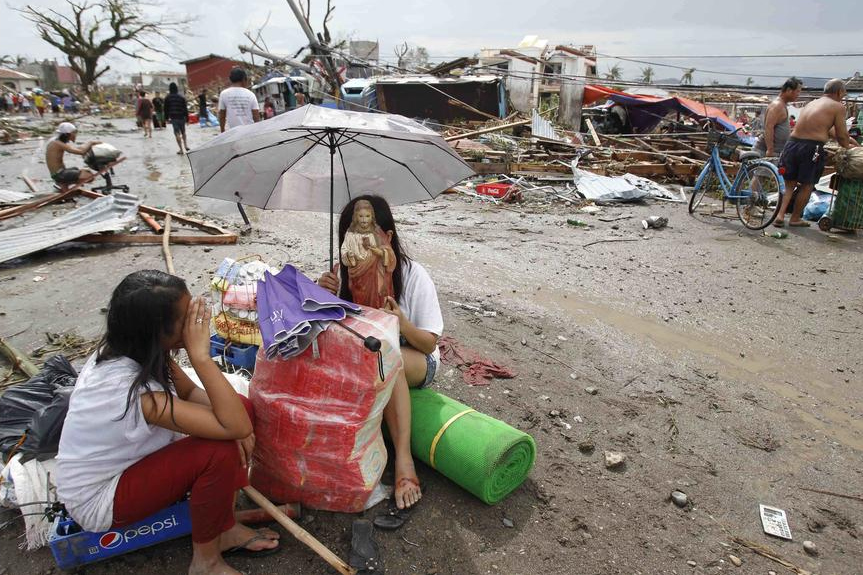
First, is the World of Godlessness. Because of what happened, people turned back to God in prayers. Because of what happened, many turned back to their  faith to get consolation and assurance. One image that really helped console me was this picture of two girls, I presume they’re sisters, sitting down facing each other, surrounded by debris and rubble, with only little belongings in front of them which includes a statue of the Sacred Heart of Jesus. It just goes to show how much their faith in God meant for them. Because of what happened, many people, listened to the voice of God in agony calling them in the silence of their hearts to offer prayers and sacrifices for the victims of that terrible event. The world of Godlessness is slowly breaking, in that people are moved to rediscover their hope, to reassess their faith and to show their love and solidarity with the many who are suffering.  

Second, the world of selfishness, self-centredness and indifference was being crushed. It’s just amazing how people moved out of their comfort zones to help in any way they can. Just yesterday, one  lady in the nursing home, frail as she is, who gave us a $100 dollars to help some people in the Philippines. It moved me, because if she lived on a pension, that amount was a big chunk from that. Another incident is, yesterday I got a call from someone in Horsham, wanting to help. It’s 2:30 hours from here, but he said he would drive down here next week to deliver his donations. Another thing that is greatly uplifting is the humble gesture of  a family of refugees from Thailand who is now living in our city, of giving us some of their belongings for the victims too. It’s just amazing how this event moved people all over the world to get out of their world of selfishness, indifference and out of their comfort zones to help out the most needy at this very moment.

Third, the world of idleness is being transformed into a community of giving, a community of solidarity and a community who works for the benefit of many.  It is being transformed into a world of working, volunteering for the relief campaigns, working as part of the medical team, or working as a team providing security and order, and in many other ways and forms of collaboration. The whole world is working together to help the victims and it’s overwhelming. St Paul would be happy with this, because this is what he was hoping for, for the Thessalonians in our Second Reading today…See in St Paul’s time, some people were also caught up with the thought that the world is ending soon so they thought there’s no point of working if all would go for nothing when the world ends. But then again, we don’t know when, what we could do now is to prepare ourselves for it, by doing something good, beneficial, life-giving and spiritually nourishing. And to be able to realize we are to move out of our world of idleness and become examples of generosity and diligence for others to follow as St Paul would urge us today. I have witnessed this world of idleness being transformed not only because I have seen it on TV or on the papers, but I have seen it personally. Yesterday, I have invited the Filipinos to help us pack the relief goods to the Philippines. To my surprise, many people turned up offering their valuable  time on the weekend, Australians and Filipinos alike, and because of the diligence of many, we packed 50 boxes of relief goods ready to be sent over.

Thus, for us, people of hope, and people of faith, it’s not the end of the world yet. What happened around us are signs from God telling us to end the ‘little worlds’ we are creating in ourselves, to move out from there and go back to him. These events are signs for us to make an end of selfishness, of our laziness and of our Godlessness. God is giving us opportunities here to re-assess our lives, to ask ourselves: Does God mean the world for me?

If He is, then  let us find him as he suffers with the Filipinos affected by the Typhoon Haiyan. We can only find him though  if we get out of our comfort zones, get out of our comfort world and allow God to create a new world, a world of love, of giving, and of caring for one another. Amen.


Leave a comment

The Resurrection: The light at the end of the tunnel

Homily for 32nd Sunday in Ordinary time year C 2013

light at the end of the tunnelLast month some parts of the Philippines had been hit by a 7.2 magnitude earthquake. It caused damages in homes,centuries-old churches and other infrastructures. And just the other day, these same people more or less had to face another blow. The strongest typhoon in the planet to hit landfall this year occurred. It’s just like adding salt to a fresh wound. It worried me  because my family is in there. I have been trying to contact them since Thursday. I couldn’t reach them. Last night I got in contact with my sister very briefly before the communication was cut off again. She told me they’re alright, much to my relief. But I’m still worried about my other sister, she’s living right in the coast. I have tried to ring her but no response. The typhoon has passed now and heading to other parts of South East Asia, but the devastation it left was massive and heartbreaking. It always broke my heart to see the suffering of my fellow Filipinos. The footage of the devastation, the debris everywhere, is just heartbreaking to see. It broke my heart because, I know, for many of those affected, their houses are gone, their only place of refuge, and many of those are not insured either, so in times like this, they had to start from scratch again. For many of these people they lost everything, houses, farms, their crops, and other means of living. Another thing that got me was the image of death. One scene there was this father pulling out the dead body of his son from under the rubble. It was really a  heartbreaking scene.

It breaks my heart to see people dying in such a terrible way. It breaks my heart to see people lost everything they’re working for over the years. Do you know what consoles me this time?

My Faith in the resurrection and my hope for eternal life.

I thank God for giving me hope, I thank God for giving me faith in the resurrection. If there’s no hope for resurrection, I don’t know how to take this reality of death and devastation happening now in my beloved country.

This faith and hope are our consolation and  source of comfort as we continue ‘walking in the shadow of death’. We can be assured of this faith and this hope because of Christ who had not only told us about this, but really showed us this in his life, death and resurrection. Jesus has died as we always proclaim in the Profession of Faith every Sunday in the Liturgy, but HE didn’t end up in death. He died but he defeated its power by rising from the dead. And this is one of the messages he likes to tell us in the gospel today. He is telling us that there is more to death than just being the end of our life. He shows us that there is more to life than our life here now, that there is life after death, that there is resurrection after our death.

Thus, we need to develop in us the gift of faith in the resurrection. It is very important for us to realize how powerful belief in the resurrection is and how important it is to have faith in the resurrection.

How important the faith in the resurrection is for us?

First, it is power for us. It is an engine if you like that keeps us going. The beauty of this power is not  that we can be arrogant and be proud of who we are or what we have achieved, but rather it makes us humble yet strong even in the face of adversity, or defeat or even in imminent death. The story of the seven brothers and their mother in the Book of Maccabees that we heard today is a good point to reflect on, for us to understand faith in the resurrection as a power. We heard that the brothers were tortured because they wouldn’t give in to whims of the King to deny and to disrespect their religion and their faith. Because of their faith and hope in the resurrection, they were able to stand up courageously and played indifferent to the sufferings inflicted on them. Such was the power of their faith that one of them could even dare to speak before the King: ‘Ours is the better choice, to meet death at men’s hands, yet relying on God’s promise that we shall be raised up by him…’ Faith in the resurrection makes us humble to accept that not everything we want here on earth is  going to happen on our favour. This faith also keeps us going as we journey through this life.

Second, it is source of our hope. It gives meaning to our lives, to our endeavours, to our experiences especially in times of despair, sorrow and disappointments in life. ‘Without the hope of an afterlife,’ Otto von Bismarck once said, ‘this life is not even worth the effort of getting dressed in the morning.’ As Jesus showed us in the gospel, belief in the resurrection opens our eyes to see that there is more to life in ‘the age to come’ than ‘in this age.’ In here, he was answering to the question of the  ‘fundamentalists’ in the Jewish religion- the Sadducees, who tried to make the idea of resurrection appear ridiculous. They’ve used a hypothetical scenario of a woman who’s married to 7 brothers one after another. The Sadducees used the Law of Moses to put their point forward but Jesus could see their purpose. They were there not to learn or to understand but to disprove him, or discredit him. To answer them, Jesus told the Sadducees that in the resurrection, there is a newness of life, a new beginning, a life beyond the life that we know of, a life that is not just an extension of our human experience but a fulfilment of all that we aspire and long for, a perfection of our humanity. We just need to live in this hope while we’re still in this life.

Third, it ensures us to have a share in the life of Christ. ‘Through him, the children of the light rise to eternal life and the halls of the heavenly kingdom are thrown open to the faithful; for his death is our ransom from death, and in his rising the life of all has risen.” (Preface II of Easter). Furthermore, it not only enables us to share in the life of Christ in the future but it allows us to enjoy the company with the resurrected Christ right here and now. Sharing in the life of Christ also means listening to him speaking to us through our real human experiences as he did to his disciples on the road to Emmaus. It also means recognizing him in the breaking of the Bread (Eucharist) as he is present in us, in the Word we heard, in the Food we shared and in the Minister.

The resurrection therefore is the light at the end of the tunnel for us. Faith in the resurrection assures us of immortality. However we have the responsibility to live it out as a people of the living God here and now, in our own lives and in our own particular vocations. We are to live it out working for the fulfilment of our hope of that life with God where there are no more disasters, no more sufferings, and no more trials.

So as we continue our celebration of the Eucharist, let us renew our faith in the resurrection. What are we doing to be assured by it in the end? 

Leave a comment

Zacchaeus- the tax-collector teaches us a lesson

Homily for 31st Sunday in Ordinary time year C 2013

zacchaeus_jesusNo one who meets Jesus ever stays the same’, says Philip Yancey, an American Christian writer in his Book ‘The Jesus I Never Knew.’  Yancey continues: ‘Jesus has rocked my own preconceptions and has made me ask hard questions about why those of us who bear his name don’t do a better job of following him.

Perhaps Zacchaeus in our gospel today, could say the same thing too that “no one who meets Jesus remains the same”, because he really experienced it. There was really a change happening in his life.

And the Good News for us today is that the story of Zacchaeus is not only a story in the past, or in the time of Jesus. The story of Zacchaeus is also our story, right here, right now. This gospel is an invitation for us to celebrate God’s love, to experience God’s mercy and to renew our commitment to Christ and his message. To respond to this invitation though we need to make ourselves available for God. We need to open the door of our hearts for God to come in. We need to empty ourselves for God’s grace to fill in.

So how we could respond to this invitation? Three things:

First, is to make an effort to see Jesus- to meet Jesus in a more real and personal way even if it looks ridiculous in the eyes of the world. Zacchaeus climbed up a tree not primarily to get the attention of Jesus, but to see him personally. And thanks to all of you, especially our young people here for making the effort not only to see Jesus tonight in this mass, but to experience his presence and to receive him as our food in the Eucharist. This is also our challenge today. There are many things or situations that blocked our way from seeing Jesus.

I have heard people saying that as they got up from bed before,  they would offer a short prayer of thanksgiving to God for the gift of life, but now instead of praying, the first thing they’d do is to check their Facebook or Twitter. These are just some of the things that blocked our way to see Jesus in our lives- the kind of things that give us false assurances, false securities, false hopes- that once accumulated leaving us more empty than before. Our call today, we need to see over those things. We need to overcome all those and then we see Jesus in persons- maybe through someone who is grieving and needing a listening ear, maybe through some families who couldn’t pay their rent, maybe  a friend whose spouse is in the hospital. Zacchaeus made an effort to climb up a tree to see Jesus from the vantage point of view. This could also mean ‘prayer’ or lifting up of ourselves before God. Prayer always helps us not only to see the real situation or mess we are in, but to get out of it.

The second is to accept who we really are and as sinners before God. Again, we can learn from Zacchaeus. He was short in stature and he couldn’t do anything about it, but he could do something with it. It is a task for us to do today, because our time is characterized by ‘IMAGES’, perfect image, perfect body, Australia’s Next top model, someone with an X-Factor, or someone who’s got talent or someone with ‘the voice’. What about if we don’t have those aspects in our lives? Zacchaeus couldn’t do anything about his being short in stature, but he did something with it– that might have helped him to climb the tree quicker.

Another thing we can learn from Zacchaeus is that he didn’t let the people’s perception on him block his way nor stop him to see Jesus. As a  tax-collector, he really couldn’t avoid the common perception that he was a cheat, a traitor for the Jews, an extortionist if you like. Let them think about him that way, but that didn’t stop him to go to Jesus, to acknowledge his being a ‘cheat’ if you like before Jesus and to do something about it. This is a good thing about accepting who we truly are because through this we can also what we are capable of- that we are capable of doing good, noble and honest things not only for ourselves but for others.

Third is to listen to Jesus’ words Come down and I will have dinner at your house.’ This is a call for us to make a place for Jesus in our homes, in our lives, in our hearts. This means we let God be in the picture of our life. This means we look for God for the answers the questions in life we have, not to google it. If Christ is alive in us, real conversion occurs, and all other things we have, would pale in comparison or even fade into the background. Zacchaeus had realized this that ‘he stood his ground and said to the Lord, ‘Look, sir, I am going to give half my property to the poor and if I have cheated anybody I will pay him back four times the amount.’ Wow, what a resolve! It just goes to show that if we experienced real conversion and real relationship with Christ, things, possessions, fame, or popularity wouldn’t matter anymore.

So as we continue our celebration of the mass today, let us ask ourselves: What effort are we taking to celebrate God’s love,  to experience God’s mercy and to renew our commitment to Christ and his message? Zacchaeus did it by making an effort to see Jesus, by being true to himself before him and by welcoming Jesus into his home-his life.

How about us? What effort are we taking?

Leave a comment

Prayer: A check on attitudes

Homily for 30th Sunday in Ordinary time year C 2013

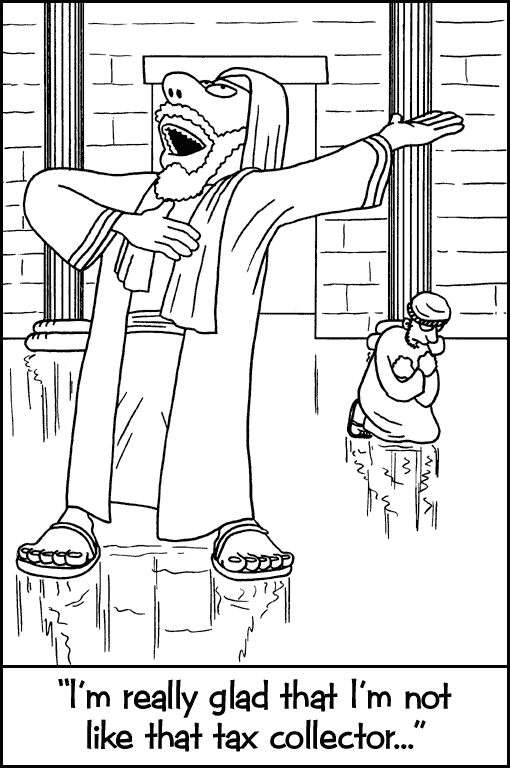
pharisee  & tax collectorA story is told of a young boy kneeling  before the Blessed Sacrament .This is his prayer. ‘Lord, I need food today for myself and for my younger brother. Please give me $20.’ The person praying near him heard his plea, so she fished out $10 dollar note from her pocket and dropped it in front of the boy. When the boy saw the money, he picked it up and without looking even at the person who gave it to him to show gratitude at least he went on with his prayer: ‘Lord, thank you for the money, but next time you’d better give it to me directly because if you give it through another person like the one beside me because she’d took half of it, and she only gave me $10 when I asked you for $20.’

This is just a snippet  of how our prayer life can sometimes be like. We sometimes pray and when our prayers are not answered the way we want, we tend to blame ourselves (that we are not praying for the right thing, or not in the right time), or we put the blame to other people even, like the little boy in the story, or at times we would tend to blame God saying: ‘God doesn’t listen to my prayers.’

How about us: How’s our predisposition or attitudes before or when we pray?

Jesus in our gospel today, is telling us some of the commendable attitudes we must develop in our life especially in our prayers.

One, is that we accept who we are, faults and all, before God. Praying is being true to ourselves and to who we are before. This must be the basic attitude, a basic pre-disposition of our hearts when we pray. This is the attitude that Jesus would say in the gospel that is ‘at rights with God’ or makes us  ‘go home justified.’ This is the attitude shown by the tax collector. And it is worth imitating and developing in our selves especially in our prayer life. But we need to be very careful if we tend to identify ourselves completely to the tax-collector in the parable. Some of us Catholics might even justify our favourite place to sit in the Church which is at the very back of the Church at Mass, or even standing sometimes, because the tax-collector had done this, and he went home at rights with God. We need to understand that in Jesus’ time tax collectors are considered traitors  by the Jews. See, the Jews believed only in one God as we do. So their loyalty should have been to this only one and true God. However, the tax collectors, i.e. living among the Jewish community, were working not for God, but for the Roman Government. The taxes they collected were for the Romans, for their projects, for their policies, to build a temple for their own gods and goddesses. So we can sympathize with the Jews if they had a certain unholy revulsion against them. So identifying ourselves with the tax-collector in the gospel today might put us into a questionable ground or loyalty. And this is not the point Jesus wanted to make by telling us the parable. Jesus is telling us rather that in terms of prayer, the tax collector has taught us a valuable lesson. He acknowledged his weaknesses, his limitations before God and his being a sinner. He didn’t even have  a personal prayer on his own even. He only used the text from the Psalm 51: ‘Lord, be merciful to me, a sinner.’ He was true to himself. He didn’t pretend to someone virtuous before God.

Two, praying is emptying ourselves for God to fill in. The Pharisee in the gospel however is doing the opposite. He is too focused on his achievements or ‘good works’ to the extent of thinking of himself as superior over another. We heard in the gospel that he mentions himself ‘I’ six times while the tax-collector  refers only ‘once’ to himself and that’s when he is ‘pleading for God’s mercy.’ Experience could tell us that we can’t fill up a glass full of water. If we continue pouring in, it just spills over and thus wasted. The same thing could be said in our prayers. If we are too focused on ourselves, we lose the connection. Experience can tell us about this too. Certainly many of us might have had a call from telemarketer before especially in the late afternoon of early evenings. I don’t know about you, but I’m sorry to disappoint you, I can’t listen to people that go on and on about their products  and not even willing to listen what I have to say. So what I’ve done few times before, I hanged up because there is no real conversation happening there. With regards to prayer, I’m not saying that if we go on and on and on, God would hang up on us. Certainly not. He is always there listening to us and what we have to say. However, as Fr Pat O’Sullivan, S.J.,  would always say: ‘Prayer is a relationship,’ and no personal relationship can flourish with only one doing the talking all the time. Thus, if we really want to have a real and personal relationship with God, let us also listen to him and what he has to say in our prayers and meditations. So in our prayers, let us strive not to be like the Pharisee who is too full of himself, as if whatever he has done is all his doing, and by doing that he is not allowing God to be real and active in his life.

Three, praying is humbling ourselves before God. The prayer of the humble ‘pierces the clouds’ as we have heard in our First reading today. Praying is not bragging ourselves before God, but acknowledging that all that we have received are God’s gifts for us. This is the difference between the prayer of the Pharisee and the tax-collector. One is bragging and the other is really praying. Furthermore, Sirach, the name of the author of Ecclesiasticus which we have heard today is also saying to about a much deeper message, and that is our prayer life should inevitably be connected to the rest of our lives.

So once again, we are asked: How’s our prayer life? How’s our life of faith in general? If our prayers are not answered yet, it might be worth asking: ‘Why, or what, or how do I pray?’ But then again, it’s a journey in faith and a call to relationship with God, so like St Paul, ‘let us strive to fight a good fight to the end, to run the race to the finish, and to keep up the faith’ that we have. Amen.