
Investing for Eternal life
Homily for 25th Sunday in Ordinary time year C 2013
 For a few months now, I have been encouraging my parishioners to give me their Australian 5 cents coins. I heard from many of them that they have accumulated this loose change and not using them for anything. So I told them to give it to me because for 20 pieces of 5 cents could buy already a kilo of rice in the Philippines and that can feed a family of 3 for a day. I am amazed of the response and of the generosity of the people. At the moment we have gathered more than $300.00 out of those donations. I’m so thankful to God for those gifts because through these we can help feed and support some poor families back in the Philippines. It is not much but because it is given heartily it means so much.
However, for a few months now, I am angered by this terrible news of corruption and plundering people’s money by some Philippine politicians. Apparently, P10 billion pesos, supposedly to be used as a Priority Development Assistance Fund (PDAF), was being plundered by some of these influential political figures in connivance with a certain businesswoman, by giving those money to several ‘Ghost’ NGO’s, i.e. organizations that don’t even exist at all. This means that all those money have been divided by these people involved and have been used to satisfy their personal and selfish interests.
It really saddened and upset me because here I am, trying to help my fellow Filipinos on ways I can, like collecting and sending used goods, or collecting your five cents coins just to help a little bit the poor and struggling families in the rural areas of Cebu, while these aforementioned politicians were taking billions of pesos and put it in their own pockets to feed up their greed and selfish interests. It is just a terrible thing to see how blinded they were by the pile of money.
No wonder Jesus described money as ‘that tainted thing’ as we heard in our gospel today. By this, he means that money has the power to corrupt us. It has the power to blind our eyes from the needs of our neighbours.
But 700 years before Christ, Prophet Amos had also noticed this corrupting power that money had for some traders in the Northern Kingdom where he preached in 760 B.C. As we heard in our first reading, the situation that Prophet Amos faced was that people were so caught up with piling up big profits by exploiting and exercising power and influence over the poor and the marginalized. The power of money enslaved them that they could only pay a lip service to God because their hearts are from it. In fact, their desire for more money and more profit motivated them to even try getting out of their obligations to the law, to God and to their faith. This is evident when they expressed their complaint saying: ‘When will the new moon be over so that we can sell our corn…by lowering the bushel (the measuring cup) and raising the shekel (the price)…and tampering the scales? See, in the Jewish Law, during the New Moon they can only sell their things or produce according to the right and just price. They can’t tamper the scales or cheat in the measuring cup. This means low income and small profit if any. Another thing is the Sabbath. On the Sabbath they are not allowed to work, so they couldn’t go on selling their stuff in the market places, thus there’s no income. Because of their desire for more and greed in their hearts they were wishing to get away with the Sabbath and with the New moon, i.e. to get away with their obligation to the faith and to God. Here again, Jesus is right in saying, we cannot serve both God and money.
But thank be to Jesus who assures us and keeps on reminding us that we have the power over money, not the other way around. In effect, Jesus is saying: ‘Use money to make friends, don’t get it wrong by using your friends to make money.’ In the gospel He is showing us that money or resources or wealth we have are meant for us to be used carefully, honestly and responsibly, and in fact to be used as an investment to secure eternal life. We are to learn from the ‘clever’ and the ‘cunning’ way that the dishonest steward used to secure his future. But this doesn’t mean we are to steal someone’s money or usurp or plunder the money of the people, and be clever enough not to be caught. According Francis Moloney, a Salesian priest we need to look deeper and farther not only for our immediate future but also for the ultimate future we all long to enjoy- the eternal life with God. Fr Moloney wrote: ‘If such cunning can be used to ensure the life of a steward in his administration of the things of this world, how much more should we, who have been called to share in the treasures of the kingdom, commit ourselves to the administration of its inestimable treasures.’[1]
So how can we invest our money for eternal life?
One. Prophet Amos (Amos 8:4-7) would offer us one way as can be reflected from our First reading today and that is to consider the poor and to be generous to the needy. We are to remember that we can’t take money with us when we die, but we can use it now (responsibly and honestly) to help us prepare for the life to come.
Two. Jesus in our gospel (Lk 16:1-13) also offers another way by saying: ‘Use money, tainted as it is, to win you friends, and thus make sure that when it fails you, they will welcome you into the tents of eternity.’ Here, Jesus urges us to venture into real and personal human relationships. Money doesn’t last forever, but relationships continue and linger. But Jesus here makes some qualifications as to what sort of friends we are to make- and that they should be the ones who ‘will welcome you into the tents of eternity.’ This means we are to look for friends who lead us to Jesus, one who walks with us in our Christian journey, and who stays by us no matter what the circumstances are. We need a friend or friends like those friends of the paralytic man in the Gospel who upon finding no way to get into the house where Jesus was, took him up to the roof, removed the roof above Jesus, and lowered their friend down for Jesus to see and to heal him (Mk 2:1-12). This is a kind of friend we need to have- one who takes the risk, and takes the initiative too for us to be closer to Jesus. And we also need to be this sort of a friend. This then calls us to assess ourselves: What sort of friends we have and what sort of a friend we are?
Three. St Paul in our Second Reading today also offers us another way, not mainly about using our money, but to invest our time responsibly by sanctifying our day and our life through prayer…i.e. ‘prayers offered for everyone- petitions, intercessions and thanksgiving- AND especially for kings and others in authority…so that we may be able to live a religious and reverent lives in peace and quiet’ (1 Tim 2:1-8.) In constant prayer, we are nourishing our relationship with God, and thus allowing him to be our life, source of strength and power everyday. Indeed, prayers help us to see our real priorities, and enable us to see clearly the real use of our resources especially our time, our talent and our treasures.
So we continue our celebration of the mass today, let us ask ourselves: How responsible are we in taking care of the resources especially money that God has given us? We still have time to correct ourselves if we have been dishonest, irresponsible and wasteful- and the time is NOW.
[1] Francis Moloney, SDB, ‘This is the Gospel of the Lord’ 25th Sunday of the year C
“The measure of love is to love without measure”
(Every week I put a little commentary on the Sunday Readings into our weekly parish bulletin. Here’s what in ‘Fr Junjun‘s corner’ in this week’s bulletin.)
Fr Junjun Corner 24th Sunday in Ordinary time year C
“The measure of love is to love without measure,” St Francis de Sales once said. This means loving without counting the cost, loving unconditionally and selflessly, and loving the other even if the other is difficult to love or even seem unlovable. This is the kind of love that Jesus wants us to learn from the parables he told us in our gospel today. We heard of the parable of a lost sheep, a lost coin, and a lost prodigal son. The message in here is that God the Father loves not only all of us, but he loves each one of us individually. We are all important and priceless in his eyes. If not he wouldn’t have sent and risked his only Son to us and to save us from our sins. In a way Jesus is saying, in the eyes of God nobody is no one because everybody is someone for him. This is wonderful realization but this is not a dispensation for us to keep on sinning.
Like the prodigal son, we are not to be content only with realizing our own sinfulness, value and worth and say: “How many of my father’s paid servants have more food than they want, and here am I dying of hunger!” Rather we are to make the decision to go back to the loving embrace of the Father, humble ourselves, and say: “I will leave this place and go to my father and say: Father, I have sinned against heaven and against you…[I am very sorry!”
We can only realize this in our lives if we keep in mind these two important things: (One) God is always there waiting for us, ready to welcome us back anytime, and (two) We must decide for God now and live in his ways.
A concrete way to decide for God is to spend some times with God in prayer everyday especially in this time when the world and the hearts of everyone need that peace that God can only give.
May you all have a blessed week everyone.
Fr Junjun
God: Unconditional lover
Homily for 24th Sunday in Ordinary time year C 2013
 A week ago, Pope Francis made news again by calling an Italian woman telling her that he will baptize the child personally as a token of the woman’s courageous decision not to abort the child even if the father “who unknown to her, was already married with a child and who demanded she terminate the pregnancy.”[i] Ana Romano wrote to the pope about her concern because she had ‘no one else to turn to’. Unexpectedly, the pope rang her and assured her she is not alone. She said:
‘‘He reassured me and said a child was a gift from God, a sign of Divine Providence and that I would never be left alone. He said that as Christians we should never be afraid. ‘He told me I had been very brave and strong for my unborn child. I told him that I wanted to baptise the baby when it was born but I was afraid as I was divorced and a single mother but he said he would be my spiritual father and he would baptise my baby.”
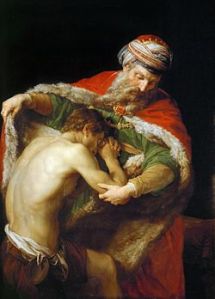
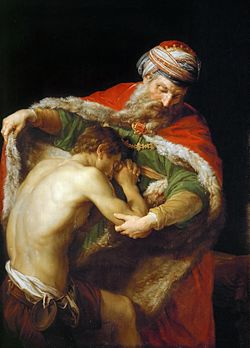
It is just amazing to see right before us, in our day and age, the attitude of the Father of the prodigal son that is still operating actively in so many of us like that of Pope Francis. On this Sunday, we are reflecting on the gospel about the lost sheep, the lost coin, and the prodigal son. But for the purpose of today, I’d focus more on the story of the prodigal son because this speaks so highly about us, about our tendency to go on our own, to take matters into our hands and to misuse our freedom.
We might have heard this gospel of the prodigal son so many times. Many times we might have identified ourselves with the younger son or the older son or the Father in the story, but this gospel speaks loudly more on the one basic attitude of our God– that of loving us unconditionally. He loves us so much that he’d take all the trouble, all the risk and all that it takes just to show us that he cares.
How did he show this?
Three things from the gospel:
First, he gave to his son the share of his property, with no strings attached. He didn’t say: ‘I’m not dead yet, and you already ask for your share, you’re killing me. Okey, I give this to you, but don’t come back to me when things don’t go right with you.’ But it wasn’t the case because our God is a generous giver. This is the beauty of our God. He gives without counting the cost.
In more ways than one, God has given us a share of his property, the life we have, the air we breathe, the food we eat, the beauty of nature, the people we can love and can love us back, the salvation we need, and million other share of his property.
How many of these gifts are we taking for granted? How many of these gifts are we wasting?
How grateful are we to God for all these gifts?
Second, He is always waiting for us and welcomes us back with no words: ‘I told you so’ or ‘Have I not reminded you?’ We heard in the gospel, ‘When the Father saw him coming’- this implies that that the father has been waiting for his return. The father was expecting him to return anytime, so he keeps on looking for him and any sign of him. ‘Then he ran towards his son and hugged him.’ This sounds like a very awkward situation- an old man running towards his son when it should be the other way around. But God is like this. He is willing to take the ridiculous step just to show us we are lovable and worth saving. He did this on the cross. He took the risk and he didn’t count how much it cost him to love us. If we can only put this truth in our mind and heart.
Every Saturday, except today, I come here to hear confession. Even if there is no one who comes, or sometimes one, I would still sit there in the confessional- because as a confessor, I am re- presenting God waiting for any lost son or daughter of his to come and reconcile with him. If we don’t go to confession though, there is an underlying reason for this, maybe, we are tired of asking forgiveness. But we must not get tired of asking forgiveness. As Pope Francis in his First Angelus message as Pope would urge us: “Never forget this: The Lord never gets tired of forgiving us. It is we, who get tired of asking for forgiveness.”
Third, he goes out and searches for the one lost and tell us: ‘All I have is yours.’ Sometimes we failed to hear this beautiful assurance of our God because we can’t be contented with all we have. We sometimes wish to get everything we want. But this is not to be the case. Life is not about hoarding stuff. It is not having some things or many things that can make us alive. It is loving what we have even if we don’t have much or if it doesn’t cost much.
Such is our God. But he needs us to let him be God in our lives. What can we do?
Let us be thankful for having a God like him- God who eats with us, walks with us, and even dies for us, sinners we may be. Let us also be grateful to all the gifts we have been given even those gifts that we didn’t ask or pray for. And like the prodigal son, let us strive to come back home to our God by humbling ourselves, in and through the sacrament of reconciliation and penance. Amen.
 Junjun FAITHBOOK