
Humility: Key to the Feast in the Kingdom
Homily for 22nd Sunday year C Ordinary time 2013
 When I was still a seminarian in the Philippines I was assigned in my home parish one Holy week to help out in the Holy week activities. One of my jobs was to be a crowd controller for people wanting to go to confession . For some reasons, many still think that if they went to confession during holy week, their sins would surely be forgiven. So when I went to the Church one particular morning I saw this long queue of people waiting for the priest to hear their confession. Because of the number of people, the parish priest then organized a numbering system, just like Vicroads, in order to be fair for everyone. So they have to wait for their turn to come. While waiting, I chatted with some of them and I learned that some of them had left their homes and villages as early as 6 o’clock just to get to the church earlier and to get to confession sooner. But then I noticed that there was a bit of a commotion near the front of the line. Apparently, there were two ladies who came much later than the others and wanted to butt into the queue. Some of those who came earlier had told them to go to the end of the line but they insisted to cut into the queue. I told them: ‘You should include in your confession today that you butt into the line. If I were the priest, I would give you as a penance to go to the end of the line and start again. It’s unfair for these people you know. They have been here almost three hours now, waiting, then you came in just now and wanting to push yourself first.’ I could sense they were a bit embarrassed when I reprimanded them. So to save face, one of them said to me: ‘If you want to go to confession too, you can go before me.’ I said: ‘No, I’m not going to confession. I’m the crowd controller here. So please off you go to the end of the queue, if not I’ll tell the priest about you.’ They went to the end of the line, much to the relief of many who were there earlier than they were.
This particular experience remained in me because this just reveals a typical human attitude to get the best spot and to be the first in everything even if it involves stamping on and disrespecting the dignity of others. It got me.
The same sort of attitude was shown before Jesus as we have heard in our gospel today. Some of the guests wore their pride so much by trying to get the best seats in the dining hall. But Jesus had to remind them, their attitude is not worthy of the kingdom of God. In a way, he is urging his listeners and us now to humble ourselves. Humility is one of the essential attitudes we need to cultivate and practice now to get a spot in the feast of the kingdom of God. It is very important for us to be humble. In fact, St Augustine would even call it the foundation of all other virtues. He wrote: ‘Humility is the foundation of all the other virtues hence, in the soul in which this virtue does not exist there cannot be any other virtue except in mere appearance.’
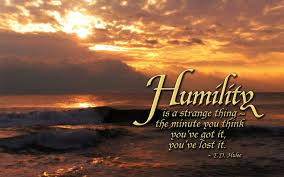
Humility derives from the latin word ‘humus’, i.e. ground, soil or dirt. When we are called to be humble this means we are touch base, to put our feet on the ground, that is to keep in touch with our humanity. To be humble is easier said than done. We can always think of many ways to be humble. For the sake of today, we reflect on three ways to be humble.
One important way and perhaps the first way is to learn from the humility of God in Jesus Christ. He said: ‘Learn from me, for I am gentle and humble in heart.’(Mt 11: 29) If he only said this we can choose not to listen to him. But because he has shown this in his life, then we as his followers, we who call ourselves ‘Christians’ are to learn from him. His humility was such according to St Paul in his letter to the Corinthians, “that though he was rich, yet for your sake he became poor, so that you through his poverty might become rich.” (2 Cor 8:9). He committed no sin but he took all punishment for our sins. He is the way, so He came down to show us the way. He took the humiliating punishment of the cross for our sake, and because of that he has changed the meaning of the cross and our sufferings. In his humility, he changed the direction and the meaning of our life.
Another way to be humble is to listen to Jesus saying to us in the gospel: ‘When you are invited for a wedding feast, do not take your seat in the place of honour.’ Jesus was on for a meal at the Pharisee’s house and he noticed that the guests were trying to get the best seat, the best spot, or the table for VIP’s if you like. This is how they behaved in special occasions like this, it’s the feast on the Sabbath. Jesus had noticed this so he took the opportunity to challenge their expectations and behaviours. In a way he was showing them that to go to a meal is to enjoy the food and the company rather than showing off to people your social status, your wealth, your power or your influence. For Jesus this is not the way to enjoy the feast in the kingdom. Ecclesiasticus or Sirach in our first reading today would add to this saying: ‘The greater you are, the more you should behave humbly, and then you will find favour with the Lord.’
Another way to be humble is to understand that “True humility is not thinking less of yourself; it is thinking of yourself less.” (Rick Warren, The Purpose Driven Life: What on Earth Am I Here for?) William Temple, the Archbishop of Canterbury in 1940’s has explained this way quite well when he said: “Humility does not mean thinking less of yourself than of other people, nor does it mean having a low opinion of your own gifts. It means freedom from thinking about yourself at all.’ This doesn’t mean though that we look down at ourselves all the time, but rather it means that we need to know the world is not just revolving around us. We are part of the network of relationships with God and with one another. This means we are to look after the needs of other people. This means also allowing other people to enter into our world and grow into a personal relationship together. This means listening to people, taking on their comments, their criticisms at times and learn from them, and strive to become a better person.
Today we celebrate Fathers’ Day in Australia. I have a fathers’ day story for fathers and this is a challenge to be humble and to listen to others even if he is your little boy or little girl saying.
A boy asked his father during meal: “Dad, are bugs good to eat?” asked the boy.
“Let’s not talk about such things at the dinner table, son,” his father replied.
After dinner the father inquired, “Now, son, what did you want to ask me?”
“Oh, nothing,” the boy said. “There was a bug in your soup, but now it’s gone.”
It pays to listen and to be humble before little children at times too. Humour aside, as we celebrate all Fathers and fatherhood today, we honour and acknowledge all fathers and father-figures for their love and sacrifice for their children and loved ones. For all fathers here, and on behalf of us all here today, thank you fathers, dads, grandpas, for being who you are and for everything you do, thanks. God bless you.
One last thing, election is coming up. Let’s us pray for discernment to know who among the candidates have the true humility to serve the country. I pray for all of you who can vote, (I can’t because I am not a citizen yet) please vote wisely and prayerfully.
So as we continue our Eucharistic celebration today, let’s pray that we may attain that certain attitude of humility before God and before others, that humble attitude worthy of the kingdom of God. Amen.
Tips for the Kingdom & for our salvation
Homily for 21st Sunday in Ordinary time year C 2013
 Last year, together with the Filipino Community in Bendigo and some Australian friends and parishioners, I organized a Philippine outreach project. I invited the parishioners to donate whatever they can give. I am amazed of the response of the people in the parish. Some gave us money to pay for the transport of the goods. And many gave us their used clothing, kitchen utensils, dinner sets, toys, books, children’s shoes, and many others. We have sent about 40 boxes out of those donations to some needy families and schools in the Philippines. When I went home last year, I met one of the recipients and he just thanked me for thinking of his family and for the box of clothes, toys, and shoes for his children. But then he said to me something that it’s hard to forget. He said: ‘You know Father, my children were very happy for the shoes they have received, because that’s the first time they ever have shoes.’ I felt like crying upon hearing that because I know those shoes are just passed on to them. They are not new. In fact, they have been taken for granted. They are given away because the owners have got new pair of shoes. Those shoes have been used or even overused before by the previous owners but even then, it gave those Filipino children so much joy to receive them.

I just wanted to share you this experience because one of the strong messages in our gospel today is that: ‘We must not take things for granted’ and in this context our salvation.’ This means we have to take every opportunity not to waste it but to cooperate in God’s grace. True, salvation is a pure gift, a pure grace of God. We don’t earn it. But it doesn’t mean we just have to sit down, do nothing, and let God do everything for us. As Catholics we believed in the value of good works, not to earn our salvation, but as an effect of fruit of grace.[1] One Jesuit priest jokingly puts it this way: ‘If you claim you are saved, at least show it in your face.’ Humour aside this means, we need to work with God for our salvation for as St Augustine would say: ‘God who created you without you, will not save you without you.’ This also means we need to take our salvation seriously because it’s not matter of preserving our life now, but it’s a matter of attaining eternal life.
So what can we do to cooperate with God’s grace for our salvation?
Let us reflect on our Readings today to get a few tips if you like.
Tip # 1 is from our gospel today (Lk 13:22-30): Be less in lip service and more in service of God and of others.
It’s not enough for us to say we believe in Christ or have faith in God or have been baptized Christians. It is also not enough for us to say we have ‘eaten and drank in the company of Christ or have heard him teaching in our streets’ as we do in every mass we attend to. Rather, Jesus is warning us to test our Sunday worship by looking at how we live at home, how we behave at work, and how we treat our neighbours. If we claim to be Christians, then let us go out of our comfort zones and work with Christ, work like Christ, and be the presence of Christ to others and to the world. Let us serve our community in whatever way we can do and in whatever capacity we can offer bringing with us the values and the qualities of Christ.
Tip # 2 is from our second reading today (Heb 12:5-13): Let God be God in our lives.
The Letter to the Hebrews that we just have heard, has explained to us how can we allow God be our only God. It says: ‘My son [ & daughter] when the Lord corrects you, do not treat it lightly; but do not get discouraged when he reprimands you. For the Lord trains the ones that he loves and he punishes all those he acknowledges as his sons [& daughters]. This is a proof for us that God cares for us and that he wants all of us to be saved by correcting us if we do wrong and training us that we may become worthy to be citizens in his kingdom.
Tip # 3 is again from our gospel today: Let us not take our faith for granted.
Faith is not a guarantee that we have the privileged position in the kingdom of God. Faith is not an assurance that we get to heaven in the end of earthly journey. Being baptized might get us to Catholic schools, but if we don’t express in the way we love and in the way we live the faith we profess, we are the ones that Jesus meant in our gospel today: ‘The first now who will be last.’ We have to remember that there are still many people out there who may not have heard about Christ and the gospel (not of their own faults) but are living their lives in the values of Christ and the kingdom. They might be the last to hear about Christ but when time comes, they would be the first to get to the kingdom. It would be unsettling or unfair for us but not if we don’t take our faith for granted. To take our faith seriously, let us celebrate it, let us live it out, let’s keep it up, and show to the world how meaningful a life would be if we have faith in God.
To young people: A way to keep our faith seriously is by going to Church to show that we are part of the Christian community as often as we can. You might say: ‘I don’t like going to Church because I don’t get anything out of it. I’m the only young person in the pew. It’s intimidating, you know.’ But I have to tell you, ‘we are to go to Church not mainly because we get something out of it, but because of what we give in there. I’m not talking about the collection here. I’m talking about the time that we give back to God after a week long study or work.
This Sunday we also celebrate the Refugees and Migrants Sunday. And again the refugees, the migrants, the asylum seekers are a stark reminder for us of the many things we have taken for granted. Wasting so much food, complaining about broken heating units, or leaking roof, etc. while these people have risked their lives to come to Australia because they wanted to enjoy the kind of life we are living now. So today, let’s pray for Australia, for the government for us all that we may not take many things for granted especially if human life, rights and dignity are at stake. Let us pray that all of us in Australia be united in upholding the rights of each person no matter where we are coming from, what capacity we are in, and in what contribution to the country we can offer.
[1] Joint Declaration on the Doctrine of Justification (Lutheran World Federation and the Catholic Church0 No 19-20.
A test of our loyalty to Christ
Homily for 20th Sunday in Ordinary time year C 2013
Being here in Australia for 6 years has helped me so much to understand the culture and the people. This includes the footy. And yes I have a team. It’s just amazing to see how people followed their AFL team. One time, Bishop Joe took us for a tour in the diocese and because it was winter, one priest generously gave me a scarf. With joy and gladness of such a gift I wore it unwitttingly because it kept me warm. But when I arrived in the house where we were staying, one lady worker just burst out saying: ‘Take that terrible ‘black and white’ scarf off your neck.’ Another time, I went to one Church one Sunday morning to attend mass. Somebody led me to the sacristy to introduce me to the priest. I think that was the year Hawthorn defeated Geelong on the premiership, one priest who is a great fan of Geelong said to the altar boy who was proudly wearing a brown and yellow scarf: ‘Take that (I am not using the exact word here but it’s not nice) bl…ank thing out of this sacristy!’
I just said to myself: ‘Wow, is that how serious and loyal he is to his team!’ He really looked serious. Then I offered a silent wish: ‘That we will all be as loyal to Christ as we are loyal to our team.’
Friends, dear brothers and sisters, I’m sharing this with you because our readings for this 20th Sunday are also about loyalty- loyalty to Christ. Our Readings invite us to ask ourselves: How loyal are we to Christ? Are we as loyal to him as we keep up with our membership in the footy club? Are we as loyal to him as we follow our team playing week after week?
The Good News is we can test our loyalty to Christ. It’s a challenge for us though to test our loyalty to him and for our being a Christian because we are living in a relative peace. We are living in an affluent society. We are living in a country where we can be indifferent to religion. We are living in the country where we can freely express our faith as long as we don’t impose it to some other people.
How can we be loyal to Christ and to our Christian faith in Australia?
Our Readings today offer us three ways:
First is from the Prophet Jeremiah in our first Reading today and that is we must stand up for the truth of our faith no matter what it costs us or how much it costs us. We heard in the reading that Jeremiah was thrown into a dry cistern, a dry well to die and be buried in the mud because according to his opponent, “he is unquestionably disheartening the remaining soldiers in the city” (Jer 38:4), by telling them about the forthcoming defeat of the King Zedekiah of Judah to King Nebuchadnezzar of Babylon. He was also encouraging the soldiers to leave the city and in order to be saved. Effectively, he was discouraging the soldiers to fight for the king and to go out to the Chaldeans to ‘have their lives as a prize of war, and live’ (Jer 38: 2). It was very courageous of him to tell the soldiers to desert the army. But that’s the truth God has asked of him to tell the people. Jeremiah is a true prophet. And a true prophet is one who stands up and say what God says and not what pleases the king.
As Christians, standing up for the truth is a way for us to test our loyalty to Christ. To stand up for the truth now, is to continually listen to Jesus speaking to us through the Church, through our human situations and experiences. This means standing up for Christ. It is a big call because Christ may be comfort to the afflicted but he is also affliction for the comfortable. I also read somewhere that Christ is too conservative for the liberal, and too liberal for the conservative.
Second way to test our loyalty to Christ is to make it our daily resolution to ‘throw off everything that hinders us from following Christ, to keep running steadily in the race and not to lose sight of Jesus’ (Heb 12:1-4) as we have heard in our second reading today. This means that we could not just be passive in our Christian discipleship, rather we should be actively working out and willingly living out our Christian calling. A concrete example of this active witnessing of our faith in Christ is the experience of our Christian sisters and brothers in Egypt today. According the news, many of this Christians were targeted by some radical Muslim group. But they stood up for the faith. They didn’t leave the country. According to the news, they were easy target because they wouldn’t take revenge. They wouldn’t take arms against the people who were attacking them. And it is a courageous Christian witness!
The third way is really a test of loyalty to Christ. Jesus in the gospel says that he came not to bring peace on earth, but division. We might protest saying to him: Isn’t it Isaiah called you the Prince of Peace? How about that song of the angels when you were born ‘Glory to God in the highest and peace to his people of goodwill?’ Then he continued on telling that because of him households would be divided-father against son, mother against daughter.’ We need to understand though that when Luke wrote this gospel, people were still under persecutions. So understandably, there would be some members in the families who showed much loyalty to Christian faith and die for it. We have the martyrs as cloud of witnesses. There must also be members in one household who would rather deny Christ- thus causing division among them, in order to be spared from imminent death.
But this also applies to us now. By experience, we have some members in our families, friends or relatives, who couldn’t care less about the faith, about God even. So this is in a way- a kind of division that Jesus was talking about. But even if our faith in Christ caused division and tensions in our homes, in our workplaces, in our community, let’s keep up with it. It doesn’t mean this is really what a Christian is like. It means rather that if we chose to follow Christ we are called to stay focus on to him, to keep following him, even if any of our friends or family would rather choose to stay away from him. Let’s strive for the Kingdom first and then everything, and that includes ‘everyone ’will be given to us.
SO as we continue our celebration of the Mass today, let this be a point for our reflections and prayer during this week: How can we be loyal to our Christian calling and to Christ in Australia in this day and age?
 Junjun FAITHBOOK