
If only we realize how much God loves us….
Homily for 11th Sunday in Ordinary time year C 2013
 One of the strong messages in our gospel today is the beauty of realizing how much we are loved by God despite our being a sinner. When we realized how much we are loved by God things slowly change in us. We would have a new perspective on things. We would have a new attitude towards one another. Our relationships flourish. We just keep on doing good, and aiming for the best. However, being loved by God doesn’t guarantee us that we may never fall again, but it assures us that God would always help us get up from falling.

One way to realize how much God loves us is to know and accept our being a sinner. Simon the Pharisee has some problem with this. He couldn’t take this, because he thought he’s so good enough that he could easily distinguish ‘sinners’ from saints. He thought he is better than the others. Our gospel tells us a glimpse of this kind of person by telling us what Simon was thinking about Jesus and the woman who gate-crushed on his party. “If this man were a prophet, he would know who this woman is that is touching him and what a bad name she has.” Unfortunately, with this kind of attitude, it takes a lot of hard work to realize how God loves us in an unconditional way. Because with this comes the tendency to compare, to judge, to put ourselves over and above others. With this it is hard if not impossible to accept our being a sinner. However, to accept our being a sinner does not mean living comfortably with sin or in sin, rather it means continually asking God’s forgiveness and healing. If we take it as living comfortably with sin, then it is a problem. “The problem is not that we are sinners” says Pope Francis, “the problem is not repenting of sin, not being ashamed of what we have done. That’s the problem.”
Another way to realize the love of God for us is to appreciate the gifts we have received even us without asking. Sometimes, we may complain to God for not listening to our prayers. But have we ever tried counting the blessings, the graces that we have received everyday even if we didn’t ask for it. For me, a whole lifetime wouldn’t be enough to count all the blessings I have received from God so far. Though it is a valid human reaction to say that our efforts went to nothing, our prayers were not answered and that our sacrifices didn’t mean a thing for us but we have to know that God couldn’t let our effort pass without doing anything about it. To illustrate this I would tell you a true story. A man married to a Filipina shared with me his experience when he first went to visit the village in the Philippines where his wife comes from. One day he said, he went to see a running race organized by the locals. He had fun cheering the competitors as each of them got to the finish line. But this man felt sorry to the last kid who got to the finish line. He wouldn’t get any of the prizes of course. We could easily imagine him being ‘booed’ upon for taking it so long. So this man gave a personal prize money to the kid, acknowledging his effort to join the race and for continuing to run to the finish line even if all others have already finished. And the interesting thing about it too was that the money he gave to this kid was even worth more than what the champion got. All because a foreigner who witnessed the event, looked at and had appreciated the effort shown by this poor kid just to get to the finish line.
The other way to realize God’s great love for us is to keep up in our following of Jesus and be empowered by his message. The woman went to Jesus to thank him of the graces she received- the grace of forgiveness for her many sins. And in the latter part of the gospel we heard of the few men and women who now started to follow Jesus wherever he went. This is what the Church is on about. This means that we go proclaiming Christ to others through our lives. True, there are always people who would discourage us from doing so. It is because for some Jesus Christ does not only comfort the afflicted, he also afflicts the comfortable. But as St Paul would encourage us in our second reading today, because of our faith in Christ we have the right and the mission to proclaim his name to the world. By virtue of our being baptised in Christ, we are now living in Christ and thus Christ lives in us. This awareness is so engrained in St Paul that he said: ‘It is no longer I who live, but it is Christ who lives in me,’ [Gal 2:20.]
So as we continue our Eucharistic celebration today, let us thank God for three things: the gift of the Sacrament of Reconciliation, the opportunity he has given us to live our lives to its fullness, and for giving us all the graces that we need to live.
Let us always remember, God does not just look at us, he looks at us with such a loving gaze.
Feeling sorry- and doing something about it: Our Call
Homily for 10th Sunday in Ordinary time year C 2013
-
 About four years ago my 14-year-old nephew was diagnosed with Leukaemia. For only a few months after the initial diagnosis, he went downhill very quickly. His elbows and knees were swelling and that made him unable to walk. My family told me this while I was at St Kilian’s parish doing my pastoral placement as part of my seminary training in Melbourne. I wanted to do something for my nephew but I didn’t know what to do. I wanted to have him hospitalized but the cost, since it needs a specialist doctor and a special treatment, was just unaffordable. To offer him a bit of a relief I wished I could only buy him a wheelchair to at least ease up his suffering until he dies. The whole family then was just expecting that he would die in a matter of days. I’ve shared that wish to one of the parishioners of St Kilian’s. News then spread among some parishioners about my wish for a wheelchair for my nephew. I believed that some good parishioners might have felt sorry for the situation and wanted to help. Before I left the parish to go back to the seminary, they organized a leaving collection for my nephew. The generosity was overwhelming. With the donations I received I wasn’t only able to purchase the wheelchair. I was able to put him into the hospital for an immediate attention. And that made so much difference not only for my nephew’s life but also it eased up the burden for the whole family as well.
 -
Friends, dear brothers and sisters, I am sharing this personal story with you because this is just a beautiful illustration of how far can our generosity, our hearts, our compassion can go. I’m also sharing this with you because this reminds us that it is not enough to just feel sorry about something without doing anything about it. My nephew is 18-year old now, still having leukaemia though, but getting on with life. If it were not for the people who felt sorry for him and had generously helped out of their own means and resources, he would never have gone this far. Without the people who have felt sorry for him and had done something for him, he would never have lived another 4 years in his life, and counting. And by the grace of God, I’m praying and hoping that one day, he would be completely cured of his leukaemia.
-
Friends, feeling sorry about an unfortunate or desperate situation or person is good but it is much better if we do something about it. If we do something about it, it will go a long way. It will even motivate and encourage people to continue living despite the trials and difficulties they may have to face.
-
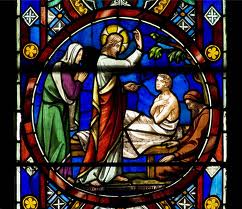
This is what Jesus shows us in our gospel today. When Jesus saw the widow and realized that she’s on her way to bury her own and only son, he felt sorry for her. He felt sorry for her because, in Jesus’ time, widows are mostly marginalized and more than not they were being neglected. In the case of this widow, the death of her only son could put her into a worst situation and into a life of misery, because around this time, women only had very little or even don’t have rights to own property in their own name, even worst for widows. It was always in the name of the male person. If her son was alive, the widow could claim ownership to some property necessary for her and for her son to survive. But he’s dead, and now she’s on the way to bury him. Jesus realized all this. This is one of the reasons why Jesus felt sorry for her. He was so moved with pity that he couldn’t let the opportunity pass without doing anything about it. And so we heard him utter one of the most consoling words from: ‘Do not cry.’ Then he called the young man to get-up- to rise from the dead. In doing that, he showed that there is still hope and life even if things seem to be desperate and hopeless. He did even more. The gospel tells us that Jesus gave back the young man (alive) to his mother. In doing this, Jesus ‘gave’ back to the woman her own dignity, her assurance, and her rights to be able to live decently and modestly. Jesus felt sorry and he did something about it- something that enables her to live and to live her life with her son, full human life.
-
Helping others especially the needy, the vulnerable, the homeless, etc. in ways we can is also our mission. But we need to make distinction between a mission and a career. St Paul in our Second reading today in his letter to the Galatians wrote about being a Jew- and being a practicing Jew was his ‘career’. The thing about ‘career’ is that most of the time anyway, we only do what is expected of us to do, or what we are told to do. St Paul would agree to this as he wrote: ‘How merciless I was in persecuting the Church of God…how I stood out among other Jews of my generation.’ St Paul was taking his ‘career’ seriously to show that he was a real practicing Jew. However, God has called him to let go of his career and embark on a mission. Like career, mission is also doing what is asked of us to do, as we believed to have been given to us by Jesus himself before he ascended into heaven and during the Pentecost. However, unlike career, there’s no turning back, there is no retirement, there’s holding back being a Christian.
-
Being a Christian is not a career that we could easily put off if we are fed up with it. It is not a career that we can retire if we feel not like doing it anymore. Being a Christian is our mission- the mission to proclaim Christ, to be with Christ, to work with Christ and to work like Christ. As a mission, this must not fade; we must not retire to be a Christian. In fact, to carry out this mission we even have to face the challenges, the difficulties, even to go out of our comfort zones. This mission calls us to go beyond just feeling sorry about something by doing anything about it. As our own St Mary Mackillop would say: ‘Never see a need without doing something about it.’ (1871). And I’m so glad to hear the other day, a parishioner praying for some CEO’s of some companies or businesses who took the initiative of raising funds for the homeless by sleeping out in the open. It is just a beautiful initiative to show that they are not just feeling sorry about something or about some people but really they are doing about it. Jesus is showing us how to do it. Now it is our mission to realize it in our lives and in our world because as Christian we have the task to show to all the world that Christ is true to his words, true to his promises, and true to his love, care, and compassion for all of us.
-
In line with this I’d leave you with a clever yet a beautiful quote which I found on the paper the other day. I believed Jesus himself lived it out in his life, and he lived it very well. It says: ‘Aspire to inspire before you expire.’
Feast of Corpus Christi: A call to become Eucharistic people
Homily for the feast of the Body and Blood of our Lord (Corpus Christi) year C 2013)
-
Today we celebrate the feast of the Most Holy Body and Blood of Christ (Corpus Christi). In the thirteenth century there were two significant events that motivated the institution of this feast. First there was a debate about the real presence of Christ in the Eucharist, so this was established to respond to the debate. Second there was an upsurge in Eucharistic piety (e.g. St Thomas on Eucharistic Adoration, songs like Panis Angelicus, etc.), so this was to serve as a result of this pious devotion to the Blessed Eucharist.
-
Over the years the Catholic Church taught that Christ is really present (not only symbolically) in the Eucharist. Everytime we receive communion we are receiving the Body and Blood of the Lord though we receive him under the element of unleavened bread and wine. Today’s celebration is to reinforce our belief that He is truly present in the Eucharist.
-
During the World Youth Day in Sydney in 2008, I happened to be in a conference about the Eucharistic Miracles (i.e. stories about the Eucharistic bread or host turning into real flesh with blood). The talk was about the Eucharistic miracle happening in Argentina in 1996.
-
The story was that in August 18, 1996, Fr. Alejandro Pezet had just finished saying Mass at a Catholic church in the commercial center of Buenos Aires, when a woman came up to tell him that she had found a discarded host on a candleholder at the back of the church. On going to the spot indicated, Fr. Alejandro saw the defiled Host. Since he was unable to consume it, he placed it in a container of water and put it away in the tabernacle of the chapel of the Blessed Sacrament. On Monday, August 26, upon opening the tabernacle, he saw to his amazement that the Host had turned into a bloody substance. He informed Cardinal Jorge Bergoglio (now Pope Francis), who gave instructions that the Host be professionally photographed. For several years the Host remained in the tabernacle, the whole affair being kept a strict secret. Since the Host suffered no visible decomposition, Cardinal Bergoglio decided to have it scientifically analyzed. On October 5, 1999, in the presence of the Cardinal’s representatives, Dr. Castanon took a sample of the bloody fragment and sent it to New York for analysis. Since he did not wish to prejudice the study, he purposely did not inform the team of scientists of its provenance. One of these scientists was Dr. Frederic Zugiba, the well-known cardiologist and forensic pathologist. He determined that the analyzed substance was real flesh and blood containing human DNA. Zugiba testified that, “the analyzed material is a fragment of the heart muscle found in the wall of the left ventricle close to the valves. This muscle is responsible for the contraction of the heart. It should be borne in mind that the left cardiac ventricle pumps blood to all parts of the body. The heart muscle is in an inflammatory condition and contains a large number of white blood cells. This indicates that the heart was alive at the time the sample was taken. It is my contention that the heart was alive, since white blood cells die outside a living organism. They require a living organism to sustain them. Thus, their presence indicates that the heart was alive when the sample was taken. What is more, these white blood cells had penetrated the tissue, which further indicates that the heart had been under severe stress, as if the owner had been beaten severely about the chest.” Dr. Zugiba’s was at a loss to account for this fact. There was no way of explaining it scientifically, he stated. Only then did Mike Willesee (Australian Journalist) inform Dr. Zugiba that the analyzed sample came from a consecrated Host (white, unleavened bread) that had mysteriously turned into bloody human flesh. Amazed by this information, Dr. Zugiba replied, “How and why a consecrated Host would change its character and become living human flesh and blood will remain an inexplicable mystery to science—a mystery totally beyond her competence.” Fr. M. Piotrowski SChr
-
Friends, dear brothers and sisters, stories like this always affirms my love of the priesthood. It always moves me to realize how God loves us so much by becoming so little for our sake. To fulfil his promise of being with us always he chose to be contained in that little host (unleavened bread) to become food for our souls. I tell you that the Eucharist formed the main motivation for me to become a priest. So if you have noticed I always take time to elevate that consecrated Host, because it is always a wonderful moment for me to have that experience of a real meeting between human and divine when my human hands is touching the divine. I always tell myself: Wow! What an opportunity to be holding in my human hands the God who is my Creator, my Saviour and my Lord. That’s why I have decided at the beginning of my ministry here in this parish to have all weekday masses in the morning, because I just loved to start my day by celebrating the Eucharist.
-
“The Eucharist is the summit of our Christian life”, the Second Vatican Council taught us. Pope John Paul II in his encyclical Ecclesia de Eucharistia reflects on this even further. The Pope wrote: “The Eucharist, as Christ’s saving presence in the community of the faithful and its spiritual food is the most precious possession which the Church can have in her journey through history.” Jesus has left us this before his death to be done in memorial of him, to remind us that God loved us so much that he couldn’t just leave us with a symbol of himself, but really his own self- his own body and blood to be our nourishment in our journey towards the kingdom of God his Father.
-
We partake communion quite regularly now. The Church has given us this opportunity by modifying the traditional form of fasting after midnight to one hour before communion. We who are here today have all this opportunities to receive him in communion. So as the saying goes, ‘We are what we eat?’ have we become Eucharistic people? If we are taking Christ in our life every Sunday or everyday even for some, has Christ truly become alive and working in us?
-
To answer this, we need to go back to the gospel read today. The disciples asked Jesus to send the people off to find food and take rest. Jesus however told the disciples to ‘Give them something to eat yourselves,’ which means to use whatever resources and capacities they have to feed the people around us who are hungry. To be Eucharistic people is to ponder and to eventually imitate the selflessness of that little boy who (though unnamed, unrecognized, and unacknowledged) generously gave his five loaves and two fish to Jesus, to be blessed, be broken and be shared by all who need it. The boy could have sold his loaves for a couple of bucks but he didn’t. He just gave it away to Jesus and in turn he has become a witness of a great miracle recorded in the gospels- the multiplication of the loaves. To become Eucharistic people therefore is to be like Christ in the way we treat others, to be the instrument of God’s love, care and compassion to the needy and vulnerable, to be the concrete and living testament of the Spirit of God to counteract the many different spirits (violence, injustice, materialism, atheism, etc), that try to drive us away from our real source and real God. To become Eucharistic people is to listen to Jesus everytime we receive him in the Eucharist telling us: Don’t just search for the blessings you get from the Eucharist, but seek for me, and bring me to others.
-
So as we continue our celebration of the Corpus Christi today, let us thank God for the gift of the Eucharist. Let us thank God for his continuing and real presence among us. At the same time let us also make this as our resolution that we, in our own little ways become a truly Eucharistic people by the way we live, by the way we act and by the way we live out our Christian vocation and responsibilities in the world. Amen.
 Junjun FAITHBOOK