Easter V B 2012 Readings
 There are several passages in the
 Just being the branch on the vine: Secret of our Christian Journey
 Homily for 5th Sunday of Easter 2012
-
The other day, my friend and I took the train to Melbourne to hang around the city. The train was almost full when we left Bendigo and more passengers took on board at different stations. I don’t know what prompted me, but I just said to myself ‘Thank God’ our Christian journey is not like travelling on this train.’ I noticed that though there were many people on the train, people don’t care for each other. There was one young lady sitting across of us just didn’t care. She started painting her fingernails. Then she made her face up with layers of cream and stuff. In one station, another young lady got on board and sat beside a young man. They chatted for a while then went back to what they are doing in their own laptops. There was just no personal relationship and real communication between the many people there. If our Christian journey and life is without personal relationship, our life would have been so boring.
-
Friends, our Christian journey is not meant to be a lonely one. It is not meant to be a boring one. We are to go together. And not only that we go together but really to go hand in hand, sharing one’s life, sharing our joys and sorrows, enriching one another with our personal and unique skills and abilities. With the gift of our selves to one another, we can make our journey more meaningful and enjoying.
-
Yet we must not forget that we are in a journey for a purpose. We are in a journey, as Christians, because of Christ. Without him, we are nothing according to our gospel today. When we travel by train, once we arrived at our destination, we go on separate ways to do the things we want to do. However, our Christian journey has a sole destination-God. It might be a difficult journey, but among other things, our readings today offer us hints or tips to make our Christian journey worth a trip.
-
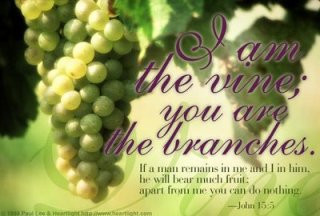
First and the most important one is in our Gospel today: to remain in Jesus. Jesus is our vine and we are the branches. As branches, we can get only get life and sustenance through the vine, Jesus. Without him, we can do nothing, John told us in our gospel today. Remaining in Jesus does not however promise us a smooth journey, or walking on a red carpet, or lying on a bed of roses. Remaining in Jesus means discipleship. And discipleship means sharing in and learning from the life our master. If he carries the cross, we can expect that we would also have crosses to bear as he said. Jesus himself told us this that God expects us to bear fruit, and we can only bear fruit if we are connected with Christ always.
-
Second hint is found in our First Reading today: to proclaim Christ in our lives more boldly, courageously and with conviction as St Paul did. Like St Paul we may be under suspicious looks by many as we start doing it, but if we are true to ourselves and to who we are as witnesses for Christ then, despite all odds we would proclaim him to all the world. No matter what the cost. Again we should not forget that we are not sole missionaries of Christ. We are community, a community of witnesses. So even if our work seems to be boring, tiring, disappointing, and discouraging, if we work as a community, as one Church of Christ, then our work would be eased up. We also need to realize that as a community we need ‘Barnabas’ [son of encouragement] in this work just as we are also called to be ‘Barnabas’ for others as we work together.
-
Third hint is found in our Second Reading today: ‘to love one another.’ This is quite a difficult one because John here would tell us not to just to be contented by saying we love one another, but really to express our love in our actions, in our lives. Yes, it is important to remember that this is an important part of our main vocation- part of our calling to love God and our neighbours as ourselves. Yes it is hard, considering our limited resources and all these different persuasions that the world has to offer for us now. But let us note St Francis, St John Bosco, St Francis Xavier, St Therese of the Child Jesus, Mother Teresa. They are just few of the many people like us, who have concretized in their lives the mandate of our Lord to love. If they can do it. Why can’t we? Again, the problem always is not that we can’t do it, but because we just won’t do it.
-
As we continue our Celebration of Easter, let’s pray that we may never let go of Jesus in our lives and that we may be the concrete expression of God’s love for our sisters and brothers around us. In this way, our Christian journey would never be a boring one. Amen.
What it is to be a good Shepherd?
Homily for Easter IV B 2012
 There was a time when Australia was said to ride on the sheep’s back. The production and sale of wool was an immensely important part of our economy. Most Australians would occasionally have had some contact with sheep. Of course we didn’t call their owners ‘shepherds’: they were graziers. In the early years of settlement, there were shepherds in Australia, but these would be employees of the squatters. In the ancient world there were plenty of owner-shepherds. The kind of care they exercised over their flocks provided a good model of the care a wise ruler gave his people.
Consequently there is plenty of shepherd imagery in the Bible. As far as the gospels are concerned, we think of the Good Shepherd who, if one sheep in a hundred strays, will leave the 99 unattended and go looking for the stray. But today’s gospel, taken from St John, goes further. Jesus says: I am the good shepherd: the good shepherd is one who lays down his life for his sheep. We shall see presently that that is a development of received shepherd imagery.
Let me explain. The prophet Ezekiel wrote at about the time of the destruction of Jerusalem and the captivity in Babylon of most of the Jewish leaders – early in the 6th century BC. Jewish thinkers wondered why God had allowed these terrible things to happen to them. The common conclusion was that they had not honoured their part of the alliance which God had made with their ancestors. The exile and all that went with it was a punishment for their infidelity.
In his 34th chapter, Ezekiel records a message of comfort for the people and of condemnation for their leaders who were supposed to be their shepherds: Shepherds, the Lord God says this: Trouble for the shepherds of Israel who feed themselves! Shepherds ought to feed their flock, yet you fed on milk, you have dressed yourselves in wool, you have sacrificed the fattest sheep [and eaten most of the meat themselves] but failed to feed the flock … You have failed to bring back strays or look for the lost. On the contrary you have ruled them cruelly and violently … In view of all this, shepherds, hear the word of God … I am going to call the shepherds to account. I am going to take my flock from them … I am going to look after my flock myself. God spells out in some detail the measures he will take to care for ‘his flock’ i.e, Israel his Chosen People, and concludes: I shall be a true shepherd to them.
Then there is this promise: I mean to raise up one shepherd, my servant David, and to put him in charge of them and he will pasture them; he will pasture them and be their shepherd. I said just now that Ezekiel wrote around the beginning of the 6th century BC. King David reigned about 1000 BC. So the promise must refer to a descendant and possibly heir of David: I suggest it is a prophecy concerning Jesus the Christ.
Returning now to today’s gospel, the late, great American scholar, Raymond E. Brown, wrote that the phrase I am the good shepherd would translate more accurately as I am the model shepherd. In this sense, a model is an ideal, an example and inspiration for all who come after him. So in this passage Jesus contrasts himself with the hired hand who takes to his heels as soon as he sees a wolf coming … because he is only a hired man and has no concern for the sheep. By contrast, Jesus can say: I know my own and my own know me, just as the Father knows me and I know the Father. If any of you have not had much to do with sheep I can assure you that individual sheep can recognize their master, and an observant shepherd can distinguish between individual members of his flock.
The next verse is always trotted out during the week of prayer for Christian unity: There are other sheep I have that are not of this fold, and these I have to lead as well. They too will listen to my voice, and there will be only one flock and one shepherd. I think we can say that for many years we Catholics took those words to mean that it was God’s will that everybody should become Catholic. That’s not what the gospel says. Indeed, since Vatican II we have recognized that God works through many other Christian churches and even in some way through non-Christian religions. It is not for us to define the outer limits of Christ’s flock. When Jesus says: The Father loves me, because I lay down my life in order to take it up again. No one takes it from me; I lay it down of my own free will, and as it is in my power to lay it down, so it is in my power to take it up again; and this is the power I have been given by my Father, Jesus shows that already he has a fair idea of what lies ahead of him. He is ready to make a sacrifice never expected of other shepherds.
Let me point out that these lines occur in the 10th chapter of St John’s gospel – long before Jesus enters upon his Passion. He had come into the world to repair the alliance which human beings had so often flouted. He came in perfect obedience to his Father’s will and, in himself becoming man, was to show that at least one human being could respect the terms of the alliance. He was in control of the situation.
We also read just now a passage from the first letter of St John. Think of the love that the Father has lavished on us – he writes – by letting us be called God’s children; and that is what we are. In the ancient world, adoption conferred full rights. When a testator died there was no distinction between the biological children and the adopted children of the deceased. All were equal before the law. So the author is asserting boldly that we shall enjoy the same rights as the only begotten Son of God. It’s just that we don’t know what they are. My dear people, we are already the children of God but what we are to be in the future has not yet been revealed; all we know is, that when it is revealed we shall be like him because we shall see him as he really is.
Not for the first time, we find Scripture pointing out the responsibilities of the leaders of the community, and this is something which is always relevant. When you think about it, nearly every adult has some of the responsibilities of a shepherd. Take first of all parents. Obviously their first duty is to feed and clothe and nurture and educate their children. We notice a good deal of eagerness to enrol Catholic children in Church schools. We also notice a great deal of reticence about bringing those same children to Mass on Sundays. Yet the parents – not the school – are supposed to be the first teachers of the faith to their children. Godparents are supposed to help the parents teach the faith to the children. Their first duty is not to supply birthday presents – there is so much more to it than that. And why do Catholic parents so often choose a non-Catholic godparent? At present in secular Australia, just as formerly in communist Eastern Europe, much of the education in the faith is left to grandparents.
Our society is fascinated by celebrities, and especially by sporting heroes and pop stars. How many of them would you point out to your children as role-models?
We clergy also have shepherding tasks and readings such as we have heard today give us cause to examine our own performance. To neglect the duties of one’s state in life is a grave matter. Let us pray for one another. (Quentin.Howard)
29-04-2012
Listening to the Scriptures and Breaking of the Bread (Eucharist)
To grow into a personal and real relationship with Jesus
 Homily for 3rd Sunday of Easter 2012
-
During the week I happened to watch the episode on the reality show called ‘The Voice’ wherein hopefuls would try their luck by singing and impressing the four judges with their voices. One of those who wen to audition was a legally blind girl. She has really got a beautiful voice but what impress me all the more was her statement. She said: ‘I don’t want people to think of me as a blind girl who sings…but a singer who happens to be blind.
-
What an extraordinary sense of self-confidence, of self acceptance, of self worth. Surely, she has acknowledged and accepted her disability but she didn’t let it become a hindrance to expressing her true self and to being true to herself. She is not having false illusions of herself. She accepted who she is, yet she also discovered that there is more that she can offer despite of her limitations.
-
Friends, everyday we face all kinds of illusions. We have all kinds of persuasions that if we buy this car, or build this kind of house, or get the latest gadget, then we can be happy. But of course, we know that these things are only giving us temporary happiness or contentment. The real happiness is only found in relationship…a real and a personal relationship.
-
This is what hinders the disciples to believe that Jesus has really risen from the dead, as we have heard in our gospel today. They have an illusion of their messiah. They expected of the messiah who is powerful, invincible, has powerful followers, victorious in all respects. But the person to whom Simon Peter has made his confession as ‘the Messiah, the Son of God’ has suffered, mocked, spat upon, tortured, crucified, died, buried. Jesus was not the kind of Messiah they are expecting. What happened to him was an failure. And now these other disciples (on the Road to Emmaus) would tell them that they met the risen Jesus. They couldn’t take it. It’s too unrealistic.
-
They couldn’t belief the report of the disciples because they are still having this illusion of a powerful messiah. But Jesus reminded them again of his constant offer of personal and real relationship that would help to get over with their false illusions. He invited them to ‘touch him and see for themselves’ the wounds he had on his body. They did and they believed in him, our Gospel today tells us.
-
Because they responded to the invitation of Jesus their false expectations, their illusions of a messiah was purified. They became true witnesses of him, of his love and of his forgiveness. So even if we hear Peter in our First Reading today telling the Jewish authorities rightly and bluntly that they were the ones who killed the Christ, the messiah, he didn’t bear grudge on them. The disciples who have now seen the real Jesus and who have understood the real meaning of a messiahship, have now braved the threats of death and persecutions just to preach to all people the risen Jesus. Hence we heard Peter after telling the Jewish leaders of their terrible act of crucifying the Lord, inviting them to repent of their sins, because Jesus Christ, has come to save everyone from sins.
-
Friends, it is really just through a personal relationship with Jesus that our false expectations and illusions would collapse and crumble. He is the way, the truth and the life’ according to John. If our relationship with him is real and personal, we come to realize that there is more we can offer to the world and to everyone rather than just lamenting on our particular circumstances and life’s situations.
-
How can we develop and grow into a personal relationship with Jesus?
-
Our Gospel offers us a way…to listen to the Scriptures. If we hear the report of the disciples who were walking with Jesus on the road to Emmaus, we know that in Jesus the Scriptures, the Word of God has really come alive and was made flesh. ‘Are not our hearts burning when he explained to us the Scriptures?’, they asked. It is so because they listened to the Word of God in the light of Jesus. They didn’t interpret it themselves. They let Jesus speak to them in the Scriptures. Reading a passage of a Scripture everyday would be a very good start to grow and nurture our relationship with God.
-
Another way is to share in the communion, or to break the bread and share it with one another. This is the Eucharist. It is very important indeed because the Eucharist is the source of our life. And more…it is the summit of our Christian life, according to the Second Vatican Council. In the Eucharist we can touch Jesus in our hands and receive him as our food. St Justin Martyr, one of the great Fathers of the Early Christian Church would attest to this, when he described the meaning of the Eucharist as they (the early Christians) celebrated it once a week. He wrote: For we do not receive this food as ordinary bread and as ordinary drink; but just as Jesus Christ our Saviour became flesh through the word of God, and assumed flesh and blood for our salvation, so too we are taught that the food over which the prayer of thanksgiving…has been said, the food which nourishes our flesh and blood by assimilation, is the flesh and blood of this Jesus who became flesh.’ In other words, in the Eucharist Jesus does not only come to feed us, but he really has become our food as well. The Eucharist therefore is a great way to grow into a deeper relationship with God in Jesus. Such is the beauty of our Eucharist. We are not just here to fulfil our Sunday obligation. We are not just here to sit down and rest after a whole day of worrying and of doing many things. We are here because we are called into a personal, real and intimate relationship with our Lord.
-
So as we continue in our Christian journey let’s pray that God would break our false expectations and our illusions, so that we can really the real meaning and essence of things. Let’s do this by loving the Scriptures and by actively engaging ourselves in every celebration of the Holy Eucharist. In this way, we can grow into more real, more intimate, more personal and deeper relationship with our God. We can know this, if the reason and the motive of everything we do is like Jesus to fulfil the will of his Father. Let this be our prayer.In and through personal relationship with Jesus, we can know who we really are and accept everything that we are.
 Junjun FAITHBOOK