2 Comments

Easter Sunday 2012: Good News

 On any day you can look into the classified advertisements in the newspaper and you will see announcements of births and announcements of deaths. You will never see a report that somebody who had been executed, whether by firing squad, or lethal injection, or decapitation, or electrocution or hanging – in short, somebody who has been executed by professionals, has returned to life. Occasionally a person who appears to have died revives – but not if someone has thrust a spear into their heart.

 No, we know that death is permanent. There are three incidents in the gospels where Jesus brought people back to life. The first concerned the son of the widow of Naim. Jesus met the cortege carrying the body to the ceremony. He was moved to pity, and revived the boy. Was he really dead, or in some kind of catatonic trance? We can’t tell at this distance. The second case was that of the daughter of the synagogue official, Jairus. Jesus was brought to her a short time after she had been pronounced dead, and restored her to life. 2000 years later we cannot be sure that she really had expired.

 The case of Jesus’ friend Lazarus is different. When he got word that his friend was ill, Jesus said: This sickness will end, not in death but in God’s glory, and through it the Son of Man will be glorified. Instead of hurrying to Bethany to see Lazarus, Jesus stayed where he was, on the far side of the Jordan, for two more days before saying to his disciples: Let’s go to Judaea. Then he told them: Lazarus is dead; and for your sake I am glad I was not there because now you will believe. But let us go to him. By the time they reached Bethany, Lazarus had been in the tomb for four days already. When Jesus ordered them to remove the stone from the entrance to his tomb, they did not want to: they were sure decay would have set in by this time. As you know, when Jesus called: Lazarus, come out! he did so, his feet and hands bound with bands of stuff and a cloth round his face. They had to untie him.

 Since Jesus had told his disciples clearly that Lazarus was dead, he must have been. Needless to say, word of this got around. Some time later when Jesus was back in Bethanyhaving a meal with his friends: A large number of Jews heard that he was there and came not only on account of Jesus but also to see Lazarus whom he had raised from the dead. Everybody wanted to gape at Lazarus, you see. No word of Lazarus’ is recorded in scripture, so we don’t know if he was happy to be back in the world of the living. Furthermore, he was going to have to die again in order to enter into eternal life.

 This morning, in St John’sgospel, we’ve read the story of the discovery of the empty tomb. It was Mary of Magdala who made the discovery and came running to Simon Peter and the other disciple, the one Jesus loved. When last heard of, Peter had been able to go into the high priest’s courtyard, thanks to John, but it was there that he denied knowing Jesus three times before cock-crow and, filled with remorse, went outside and wept bitterly at his own cowardice. John stayed close to Jesus, and he was the only one of the Twelve who stood with the Three Marys at the foot of the cross. He seems to have been close to Peter too, because when Mary Magdalene came running with the news she found the two of them together. At this point in the gospel everything speeds up. So Peter set out with the other disciple to go to the tomb. They ran together, but the other disciple, running faster than Peter, reached the tomb first. John seems to have been the youngest of the Twelve, so we can understand that he could outrun Peter. Nonetheless, he respected Peter as leader of the group, and waited for him to catch up and enter the empty tomb first. Peter just saw the way the grave cloths were disposed … Then the other disciple who had reached the tomb first also went in; he saw and he believed. The evangelist adds that: Till this moment they had failed to understand the teaching of scripture, that he must rise from the dead.  

 At Mass each day this coming week we will read accounts of Jesus appearing to different groups of people after his resurrection. What is striking is that he never showed himself to the members of the Sanhedrin, or to the chief priests, or to Pontius Pilate – not to any of the people who had brought about his death. It may be helpful here to recall that, during the Last Supper, Jesus, talking about his departure from this world, said: Anybody who receives my commandments and keeps them will be one who loves me; and anyone who loves me will be loved by my Father, and I shall love him and show myself to him. In other words, Jesus was only going to show himself after the resurrection to those who already believed in him. In this morning’s first reading, Peter explained to Cornelius and his household that he was one of the witnesses to Jesus’ death and to the fact that three days afterwards God raised him to life and allowed him to be seen, not by the whole people but only be certain witnesses God had chosen beforehand. Now we are those witnesses – we have eaten and drunk with him after his resurrection from the dead.   

 Their testimony is not just to a unique historical event. Peter goes on: It is to him that all the prophets bear this witness: that all who believe in Jesus will have their sins forgiven through his name. The Acts of the Apostles record several of Peter’s sermons, and in them forgiveness of sins through Jesus Christ is a constant theme. It is not spelled out in this passage, but I think we all know that if we have been forgiven, it is up to us to live from now on in the way that we failed to do in the past. In other words, we must avoid sin and glorify God with our lives henceforth.

 I don’t suppose any of us are terrible sinners. I hope we have never committed a mortal sin. In the passage from the epistle to the Colossians that we heard just now, Paul seems to envisage adults who have recently been baptized. Since you have been brought back to true life with Christ, you must look for the things that are in heaven … Let your thoughts be on heavenly things, not on the things that are on the earth, because you have died, and now the life you have is hidden with Christ in God. This requires some explanation. First of all, in urging the reformed Colossians to look for the things that are in heaven, Paul is not telling them to spend all their time praying. That is the task of contemplative religious. The rest of us have to earn a living, raise a family, take part in civic affairs – and so on. We should consecrate each day to God with the Morning Offering; we should be conscious throughout the day that we are always in God’s presence – and that awareness should control our behaviour. It’s not that God is a policeman, but rather a loving Father who would be pained if we turned away from him to sin.

 Insofar as anyone who has committed a grave [i.e. mortal] sin may be said to have died, that person on being pardoned is not unlike the son of the widow of Naim, the daughter of Jairus, and Lazarus: brought back to life. The same is true of a person who has just been baptized: he or she lives a new and different life in Christ. And when we pass from this world into eternal life, we shall share some of the glory of Christ. For the moment, as Paul writes, our beautiful spiritual life is hidden with Christ in God.

 If you heard me on Thursday night, you may remember that I spoke about our participation in the Eucharist as building up, or strengthening, the Christian community. It’s Baptism which brings us into that community; it’s the other sacraments which nourish the life of the community. But it is thanks to Christ’s passion, death and resurrection that each of the sacraments receives its power. Let us never forget that the central belief of all Christians is that Jesus Christ is the Son of God who suffered death and returned to life.  On this feast the Orthodox greet each other with the words “Jesus Christ is risen” to which the reply is a thunderous “He is risen indeed!” And we can add: Alleluia! (Quentin Howard)


08-04-2012
1 Comment

Meditation on the Seven Last Words of Jesus

Seven last words of Jesus on the Cross

 1.”Father, forgive them; for they do not know what they are doing.”  Lk. 23: 34.

Pater, dimitte illis, quia nesciunt, quid faciunt.

– Even on the cross, Jesus thinks of others. Not only that, he justifies those who crucified him saying to his Father ‘they do not know what they are doing’.

-We need forgiveness, and Jesus forgives us. Likewise he wills that we do forgive as well.

2.   “Truly I tell you, today you will be with me in Paradise.” Lk.23:43

Hodie mecum eris in Paradiso.

–         What a wonderful promise of his company forever. Like the thief, today we are all invited, in fact expected that we humble ourselves, acknowledge our sinfulness and weaknesses before the Lord,  expressing our faith in him, and growing in hope that there is something greater reserved for us beyond our crosses in life.

3.   “Woman, here is your son; Here is your mother.” Jn. 19: 26-27

Mulier, ecce filius tuus.

–         He doesn’t want to leave us on our own. He left us his mother to whom we can go to if we distance ourselves to him. She is full of grace, and the meeting point between the Divine God and the human face of God in Jesus Christ. In Mary we found a mother, a great mother who always looks after us even if others seem not to care…

4.  “My God, my God, why have you forsaken me?” Mk. 15:34; Mt 27:46

Deus meus, Deus meus, utquid dereliquisti me?

Eloi, Eloi, lema sabachthani?’

–         A cry of absolute abandonment, yet it doesn’t mean God has gone away. In the sufferings of Jesus, God has identified himself so completely to his sufferings and angst. Yes God loved us so much, that he took upon himself the death penalty that we deserved due to our sins. He willed to die for us to live. How great a love is that.

5.   “I am thirsty.”  Jn. 19:28

Sitio.

–         A cry pleading for care and concern from those people around him. This words has become the motivation of Mother Teresa, that really changes her life forever by not only listening to this pleading but really trying her best to satisfy God’s thirst in the situations of our needy sisters and brothers around us. How do we respond to this call of Jesus even up to now? When we drive around town today, do we care to wind down our car window and hand in some change to those people who volunteered their time today on the streets to raise funds for the benefit of many children? How about our Project Compassion boxes? Are we willingly putting some amount there to ease the thirst (moral and physical) of many people in the world today?

6. “It is finished.”   Jn 19:30

Consummatum est.

–         A statement of absolute surrender yet not giving up, since it is the fulfilment of his mission here to save us from all sins and eternal damnation. Yes, Lord, you paid the ultimate price of our sinfulness by dying for us on the cross. You accomplished your mission by laying your very life for us, thank you Lord.

7.   “Father, into your hands I commend my spirit.” Lk 23: 46

In manus tuas, Domine, commendo  spiritum meum.

–         Even if there seems to be an experience of being abandoned completely, Jesus didn’t despair.  He didn’t lose grip of God, even to the very end of his earthly life. In fact, he offered the last of his breath to his Father, thus he was glorified, because he offered his all to God, no matter what the odds are. So as we continue our reflection on this Day until Easter Sunday Let’s thank God for everything he has done for us. Let’s celebrate these days with joy of the knowledge that God has saved us from eternal death and that he reserved a place for us, in his company forever, so long as we continue walking in his path.

So as we continue our reflection on Easter triduum, let’s thank God for his great love for us that is shown by his dying on the cross for us. Let’s also express this experience of being saved in our faces. There’s no other cause for rejoicing here but our salvation in Christ. It is worth rejoicing and worth celebrating indeed.


3 Comments

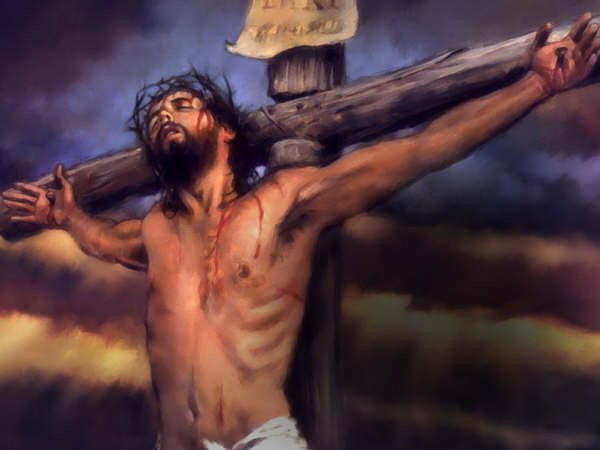
Reflection on Good Friday 2012

 Triduum 2012 Good Friday

On Palm Sunday we read St Mark’s account of Our Lord’s passion. St John’s version which we have just heard contains many interesting details which deserve our attention. Nevertheless, this year I want to concentrate on that first reading from Isaiah, which is the fourth of what we call the Songs of the Suffering Servant.

I think I told you some weeks ago that many passages of Scripture have more than one level of meaning. The first will have been relevant to people at the time it was written. But Scripture is the inspired word of God, and if something has been written down and preserved in the Bible, it may well be that it also contains a message for later generations. So far as Jewish scholars are concerned, these Servant Songs, composed during the captivity of their people in Babylon, a very low point in the nation’s history, refer to Israel itself. Israel is the Suffering Servant, being punished for her sins but not rejected. The people in exile are to take comfort from the promise that God will restore the nation.

By contrast, for us Christians, there is no doubt that the Suffering Servant is Jesus. Mark you, these two interpretations are not mutually exclusive. Both can be part of the divine plan. So what exactly does this song say? In the first verse it is actually God who speaks: See, my servant will prosper, he shall be lifted up, exalted, rise to great heights. You can see at once how easily those words can be applied to Jesus, and we remember his own prediction: When I am lifted up from the earth I shall draw all men to myself. Most of the rest of this song describes the Servant, and God will speak again at the end.

The crowds were appalled at seeing him – so disfigured did he look that he seemed no longer human. After Jesus had been scourged and mocked and spat upon, Pilate showed him to the crowd who were baying for his blood. Knowing that Jesus was guilty of no crime, Pilate would have liked to acquit him and was hoping that the crowd would be moved to pity for him. Perhaps a few were, but Jesus’ enemies kept inciting them to demand his crucifixion. On the journey to Calvary there were at least some women who pitied Jesus. So these words too can be applied to him. The poem continues: Kings shall stand speechless before him; for they shall see something never told and witness something never heard before. I don’t think there were any kings lining the path to Calvary, but over the centuries persons of every rank have been moved by looking at representations of the crucifixion and recalling that Our Lord accepted all that suffering for our sake.

Without beauty, without majesty we saw him, no looks to attract our eyes; a thing despised and rejected by men, a man of sorrows and familiar with suffering, a man to make people screen their faces. As recently as the 19th century in Europe, public executions were spectacles, and I’ve no doubt that if they were reintroduced there would be plenty of ghoulish people wanting to watch them. But even the ghouls might be horrified at some of the things people do to each other. The poem continues: Yet ours were the sufferings he bore, ours the sorrows he carried. But we, we thought of him as someone punished, struck by God and brought low. Yet he was pierced through for our faults, crushed for our sins. On him lies a punishment that brings us peace, and through his wounds, we are healed. There could hardly be a clearer statement of the redemptive power of Christ’s sufferings for us.

We had all gone astray like sheep, each taking his own way, and the Lord burdened him with the sins of all of us. The Old Testament provided for the High Priest to put the blame for all the sins of the people on an animal, just once a year, and that animal was then driven into the wilderness. The poem makes the blameless servant a scapegoat. It recognizes that the traditional rites of the Day of Atonement have not brought about any lasting change in the behaviour of the community. In the prophet’s understanding, God has taken an innocent human being and allowed the punishment deserved by the many to fall on him. That is pretty close to our understanding of the significance of Christ’s sacrifice on the cross. Like a lamb that is led to the slaughter-house, like a sheep that is dumb before its shearers, he never opened his mouth. In St John’s gospel, Jesus answers the questions which Pilate puts to him, but in the synoptics he hardly says a word – he is truly like the lamb led to the slaughter.

The poem continues: The Lord has been pleased to crush him with suffering. If he offers his life in atonement, he shall see his heirs, he shall have a long life and through him what the Lord wishes will be done. We must be very careful here: we are not in the presence of a perverse, cruel or vindictive God. Rabbi Rashi of Troyes put these thoughts into the mind of God: “I am going to see if his soul is completely dedicated to my holiness to atone for the infidelity of the people. If it is, I shall compensate him and he will see his descendants”. An American scholar, Paul Hanson, has this to say: “The Servant did not submit to affliction through pathetic resignation but as a bold choice to participate with God in an act aimed at breaking the stranglehold that sin had maintained for countless ages over the human family”. That is to say that the Servant – whom we identify with Jesus – chose to make his life an instrument of God’s healing of flawed humanity. The Servant, Jesus, conformed his will perfectly with his Father’s.

There are many injustices in the story of Jesus’ passion. The Jewish leaders who schemed to get rid of him were unjust. The members of the Sanhedrin who judged him in a rigged trial were unjust. Pontius Pilate who knowingly sent an innocent man to be crucified was unjust. The crowd who allowed themselves to be manipulated and screamed Crucify him! were unjust  – like listeners to some radio shock-jock who think and say whatever they’re told. In the midst of all this injustice, the Son of Man who was at the same time Son of God did not raise his voice or his fist, did not summon legions of angels to fight for him. He identified with the most down-trodden of human beings and never lost his faith or trust in God. There are no objective measurements of pain or suffering. What we can say is that Jesus was subjected to the worst that the men of his time could devise. Consequently no other human being can say: “You wouldn’t understand” – because God does know and understand. God has been there.

At the end of the poem God speaks again: I will grant whole hordes for his tribute, he shall divide the spoil with the mighty, for surrendering himself to death and letting himself be taken for a sinner, while he was bearing the faults of many and praying all the time for sinners. On this most solemn day of the liturgical year we can only marvel at the extent of God’s love for us, his sinful creatures. (Quentin Howard)

06-04-2012

3 Comments

Triduum Maundy Thursday 2012

Homily

Our faith is full of symbols, visible signs which remind us of invisible truths. So our first reading this evening told of the preparation of the Jewish people for their escape from slavery in Egypt. They were about to set out on a long journey and God ordered them to eat a special meal before doing so. The Church sees that escape from slavery in Egypt as a sign or symbol of our liberation from slavery to sin through the sacraments. Let me remind you that there are three sacraments specifically designed to free us from our sins. The first is Baptism. Most of us were baptized as children and probably have no recollection of it. It’s very different for adults who have asked for instruction and finally receive that sacrament which not only frees them from their sins, but also integrates them into the Christian community. Regrettably, few of us live absolutely blameless lives. Anticipating this, Jesus instituted the sacrament of Penance or Reconciliation through which we can obtain forgiveness of sins committed after Baptism. And then of course there is the sacrament of Anointing of the Sick. Even if the Christian can no longer make a confession, this sacrament will take away his or her sins.

Scripture records many meals, and some of them can be read as signs of Holy Communion, the sacrament which itself builds and fortifies the Christian community. So all those people whom Moses was to lead out of Egypt had to gather together by households to eat the paschal lamb. They had to mark the posts and lintels of their doors with the blood of the lamb they were about to eat so that the exterminating angel would pass over their houses. Rashi of Troyes was a very learnèd mediaeval rabbi. He wondered about the fate of an Egyptian who happened to be in a Jewish household on that night, and decided that the Egyptian would be spared with the rest of the household. By contrast, a Jew who for some reason was visiting an Egyptian household – not marked with the blood of the lamb – would not be spared. In other words, eating the paschal lamb helped constitute the community of those who were saved.

A key element of our faith is our understanding of what Jesus did at the Last Supper. Our second reading just now, from St Paul’s first letter to the Corinthians, is the oldest account we have of the institution of the Eucharist. Paul himself was not present at that meal, but listen again to what he writes: This is what I received from the Lord, and in turn passed on to you. In other words, at some time after Paul’s meeting with Jesus on the road to Damascus, Jesus himself explained what the other disciples had experienced that night in the upper room. Jesus had taken some bread and said these words: This is my body, which is for you; do this as a memorial of me, and similar words over the wine.

We all know that when a priest has spoken these words at Mass there is no visible change to the bread or the wine. Remember though that God’s word is enough to make things happen. God said ‘Let there be light’ and there was light. The Irish Jesuit Raymond Moloney writes: “When Our Lord says ‘This is my body’, by that very fact the creative power of the word reaches down to the ultimate reality of the bread, so that it becomes the instrument of his presence for those who look beyond the appearances. Empirically there is no change, but existentially the bread and wine are drawn into the one plan of the Creator to address us through these gifts.”

Our Lord Jesus Christ is present in several ways at Mass. First of all, the congregation gathers in his name. Then he is present in the passages of Scripture that are read and expounded. He is present in the ordained priest who celebrates the Eucharist. He is present in a most solemn way in the bread and wine once the priest has spoken the words of consecration. He is present in all those who receive him in communion. When those people go out from the church at the end of the celebration, they carry him into the world.

You might say that the whole of Scripture is a record of God’s care for his people. In addition, it contains specific examples of God providing for that most basic of human needs: food. We see it in the regular provision of manna to the Hebrews wandering around the Sinai Peninsula. We see it when Jesus multiplied loaves and fishes for the people following him. And of course he taught us to recognize where our food comes from when he said we should pray: Give us this day our daily bread. There is a passage in Isaiah which presents heaven as a banquet: On this mountain, the Lord of Hosts will prepare for all peoples a banquet of rich food, a banquet of fine wines. Jesus clearly had something similar in mind when he said: I tell you that many will come from east and west to take their places with Abraham, Isaac and Jacob at the feast in the kingdom of heaven.

It is no exaggeration to say that the Mass is a stylized banquet which anticipates, symbolises and leads to that heavenly banquet. The New Testament contains four accounts of the institution of the Eucharist: St Paul’s, which we’ve already touched on, and those of Matthew, Mark and Luke. Curiously, St John does not mention this event, even though he provides a long account of the instructions which Jesus gave his disciples at the Last Supper, and he opens it with the incident which he alone relates, and which we have heard tonight: the washing of the disciples’ feet.

We have already mentioned the fact that sharing a meal helps to build community. Sharing the Eucharist is a vital part of building Church. Receiving the Body and Blood of Christ in Holy Communion draws us closer to Christ – but it also draws us closer to each other. After receiving Communion, we don’t sit around in church waiting for the last trump to sound. We return to our normal occupations, fortified by the grace of the sacrament. And we are expected to learn from today’s gospel. Jesus said: Do you understand what I have done to you? You call me Master and Lord, and rightly; so I am. If I, then, the Lord and Master, have washed your feet, you should wash each other’s feet. I have given you an example so that you may copy what I have done to you.

The Church itself is meant to be a sign or symbol of the community of the blessèd in the kingdom of heaven. God never ceases to care for us in word and sacrament. That is why he offers to strengthen us with the food he provides for our journey through life. After all, we have a task to perform: to carry his message to those who do not yet believe. (Quentin Howard)

05-04-2012