Leave a comment

Communion with God in Jesus: The Message of the Prophet

Homily delivered on the 14th Sunday in Ordinary time 

year B  (July 8,2012)

Morning Prayer  of the Church             Evening prayer of the Church 
  1. Last week, I’ve noted in my homily the fact that whether we like it or not, we’ve got the responsibility to show care and concern for the whole of humanity. I mentioned about the issue of Asylum seekers who like the woman suffering of haemorrhage, are also wishing to ‘touch’ Australia because they believed that in here they would live a better and a secured life.  We are indeed called to be in communion with this people, in their hopes, in their sufferings, in their longing for a peaceful and just life. Today’s readings offered us another important element without which our desire for communion would be too difficult to realize if not an impossible task to do. To achieve communion with all of humanity demands communion with God.

  2. Communion with God is the message of the Prophets. This is the message of Jesus for all of us (in his life, mission, death, and resurrection) with today’s Gospel as one witness to it. Through communion with God in faith  we can also establish communion with the rest of humanity especially in the cause of justice, love and peace. In latin ‘communion’ means ‘together’ or with (cum) and ‘one’, oneness, or union (unus). So, it means we (humanity  and God) are together as one in the common cause. It is no wonder, the theme of communion is almost always evident in the preaching of the prophets. When we sin we broke up our relationship with God, so He would send a prophet to remind us that God wants to re-connect with us. However, to achieve real communion today is to understand first the real meaning of communion. Archbishop Chito Tagle of Manila, in his talk given during the 50th International Eucharistic Congress in Dublin, hinted that today the idea of communion can almost mean anything depending on who is talking about it. The Archbishop said: We see in our time so much exchange of words happening at high speed and across national boundaries. But unfortunately the world is as divided as ever. Why is communion not achieved in spite of the exchange of words? Because Jesus is not the word they share and receive. When financial wizards talk about ways of manipulating the economy for their own profit, you do not call that communion – that is corruption! When politicians talk to people about grand promises without intending to fulfill them, you do not call that communion – that is cheating! When the powerful “negotiate” among themselves while neglecting the weak, you do not call that communion – that is oppression! When so-called enterprising persons deal with each other on how women and children could be profitable merchandise [in the Philippines, there is still a great issue about Reproductive Health Bill], you do not call that communion – that is slavery!

  3. To achieve real communion therefore, is to  preach Jesus by living out our Christian faith in and through daily life, endeavours and work. ‘When communion consists in Jesus who is the Word of Life’ Archbishop Chito adds, ‘then the common good becomes central and that is pleasing to God’s eyes.’ We must preach Jesus then to others,  because he is the one who shows us the real and perfect pattern of communion in the life of the Trinity. It might be hard to understand this mystery of our faith, but as one priest commented: ‘Though the mystery of the trinity is so difficult to unravel but the main thing is that they got on so well together, and so are we.’ We are not called to bring ourselves in preaching, says Bishop Joe  on my ordination to the diaconate in 2010, but who we represent and who we stand for – Jesus Christ.’ The Bishop continued: ‘Make sure that you always give room to our God to console, heal, encourage, empower, forgive, rejoice, and to do whatever is necessary to our people.

  4. By virtue of our baptism, we gained the privilege to hold our heads up high and preach Jesus to others  because we share in the prophetic function of Jesus. Like Ezekiel in our First Reading today, we may face indifference, denial or even obstinacy from among the people but let’s keep up with it. Let’s do it and make people see ‘that there is a prophet from among them’ (Eze 2:5). In our preaching we may have to face our very selves, with our human limitations and weaknesses (thorn in the flesh) as St Paul had  confessed in our Second Reading today (2 Cor12:7), but with Jesus, in Jesus and through him, we come to accept our own humanity and even allow God to utilize our weaknesses as his power to reach out to people. We may have to face  rejection (even from among our closest relatives or friends) as Jesus had experienced in our Gospel today (Mk 6:1-6), but we know that with this experience of being ridiculed and not given credit, we are personally and intimately experiencing the  experience that Jesus had. Thank God for our faith, because with it, we are and can be assured that who we are or  what we have now is not all there is. With faith we can hope that there is something more, something greater and something better reserved for us if we  just persevere to the end…while trying our best to keep in constant communion and communication with our God. Jesus shows us how to engage in this communication, so let’s keep his company and let’s not lose sight of him. Let this be our prayer.

2 Comments

The Marks of the True Prophet

Homily for the 14th  Sunday in Ordinary time 2012 (year B)

One of my favourite cartoon characters is Garfield.  I like his clever and short lines but have substance in it. One of the  things he said which made me think really is this: ‘I can’t like everything, because a lot of stuff stinks.’ It takes time and wisdom to say this though. Because it is true, we can’t just take everything as they appear to us, because not everything is what it seems to be. There are things that are too ordinary for us. And there are also things that are too good to be true.

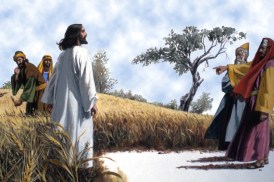
This is the underlying reason why   the People of Nazareth couldn’t believe in Jesus, as we heard from our Gospel today. They couldn’t see Jesus as a prophet because for them he is too ordinary just like anyone of them. He is just the Son of Mary, their neighbour. He is just a carpenter. They couldn’t believe in what he was telling them because they were pre-occupied with the question where did Jesus get all his wisdom, when he is just a humble inhabitant of Nazareth, and whose family they all know about. They couldn’t believe in him, in his words and miracles because for them he is too  good to be true.

The marks of a true prophet?

Five descriptions of a good and true prophet based on our Readings today.

First a true  prophet is one who would speak and stand for the truth even if the people seemed to be so obstinate or defiant of the message as Ezekiel noted in our First Reading today. ‘Whether you listen to my message or not, but you know, there’s a prophet among you’, Ezekiel would tell us today. And he would add, whether you would believe me or not, but I have warned you.’ Ezekiel was showing us that a true prophet perseveres and insists in proclaiming the message by obeying what the Lord has to say to his people. He didn’t gather his own followers or form his own fan’s club, rather he urged people to come  back to God.

Second, a true prophet is one who would acknowledge and accept his weaknesses and limitations, yet continue to live out the message of the gospel on which he or she is called to do, as shown by the example of St Paul in our Second Reading today. St Paul acknowledges his ‘thorn’ in the flesh as his weakness and limitation but he accepts it as part of him. And because of that God even uses it as his power through which his message of love, care and compassion is to be preached.

Third, a true prophet is one who would remind the people to accept the gift of faith which enables them to grow into a more, real and personal relationship with our living God as Jesus tried to solicit in our gospel today. He appears to be so ordinary a person but bringing the supernatural message of eternal life and love of God for all of us, if only we believe in him and his message.

The fourth mark of the true prophet is the content of his or her preaching. A true prophet preaches communion with God. Usually God sends prophet to his people to remind them that they have broken away from him, so He wishes them to come back to him. Communion comes from the latin words ‘cum’ (with, together) and ‘unus’ (oneness, union), so this means together as one, in our case, as one with God. However, there is great challenge here to live out this communion with God and with one another for that matter because, though  the world is getting like just one global village, we are still not united in many respects. Archbishop Chito Tagle of the Philippines has pointed out this situation in the talk he gave to the delegates of the 50th International Eucharistic Congress in Dublin. He said:

We see in our time so much exchange of words happening at high speed and across national boundaries. But unfortunately the world is as divided as ever. Why is communion not achieved in spite of the exchange of words? Because Jesus is not the word they share and receive. When financial wizards talk about ways of manipulating the economy for their own profit, you do not call that communion – that is corruption! When politicians talk to people about grand promises without intending to fulfill them, you do not call that communion – that is cheating! When the powerful “negotiate” among themselves while neglecting the weak, you do not call that communion – that is oppression! When so-called enterprising persons deal with each other on how women and children could be profitable merchandise, you do not call that communion – that is slavery!

When communion consists in Jesus who is the Word of Life then the common good becomes central and that is pleasing to God’s eyes.”

The fifth mark of a true prophet is if he or she offers hope to his or her listener, a hope that is intimately linked to Jesus, a hope that things would be as they are meant to be, if we just don’t lose sight of Him. This reminds me of Bishop Joe’s homily at my diaconate ordination. He said: ‘You are not called to bring yourself but who you represent who you stand for – Jesus Christ. Make sure that you always give room to our God to console, heal, encourage, empower, forgive, rejoice, and to do whatever is necessary to our people.’

To live out our baptismal character as a prophet therefore, especially in this day and age, demands of us great courage, faith and full cooperation. Yes, we may not like everything we see and experience, because many of them really puts us down, but like Ezekiel, Paul, and Jesus in our Readings today, let’s keep up and go on. Let’s face ourselves, acknowledge who we are, accept our human limitations and weaknesses, and allow God to use as his instruments that convey love, care and compassion to his own people. Let this be our prayer for today. Amen.

Leave a comment

Prophets and Prophecy

 Homily for Sunday XIV B 2012

Today’s readings focus on prophets and prophecy, so perhaps we need to clarify our ideas about who and what they are. Prophecy was a revelation from God to the prophet, which it was his task to transmit to others. It was not necessarily prediction, although it often did involve an announcement of the consequences of non-compliance. Typically, the prophet becomes aware of an irresistible divine call: I send you! Jeremiah, for instance, tried to wriggle out of the vocation, saying “I am just a child; I don’t know how to speak”. God would have none of that: You will say … The prophet is not required to compose speeches; he has only to relay God’s words to those to whom he is sent. As a result, they will knowand they will be responsible for their own decision to heed or to ignore the word of God.

If we listen again at today’s reading from Ezekiel we find: The spirit came to me … I heard the Lord … ‘Son of man, I am sending you to the Israelites, to the rebels who have turned against me …to say “The Lord says this”. Whether they listen or not, this set of rebels shall know there is a prophet among them’.

This extract consists of just 4 verses from the second chapter of the book of Ezekiel, which runs to 48 chapters altogether. So we have not heard any specific message today. What usually authenticated a prophet’s message was either, that it conformed perfectly with earlier teachings, i.e. it renewed God’s messages to his people, or a prediction was fulfilled. You may remember the story of Naaman, the commander of the army of a neighbouring state, who was a leper. At the suggestion of a little Jewish girl who was his wife’s servant, he was sent to the king of Israel to be healed. The king of Israel said “For goodness’ sake, I can’t do that” and tore his garments. When the prophet Elisha heard this he said: Let him come to me, and he will find there is a prophet in Israel. I’ll abbreviate the story, but Naaman was healed and exclaimed: Now I know that there is no God in all the earth except in Israel.

Sometimes there arose false prophets in Israel. Moses warned the people of this possibility and said: If a prophet or a dreamer of dreams arises among you and offers to do a sign or a wonder for you, and the sign or wonder comes about; and if he then says to you, ‘Come then, let us follow other gods and serve them’, you are not to listen … That prophet or that dreamer of dreams must be put to death. In other words, the fulfilment of a prediction alone is not enough if the prophet suggests some conduct which diverges from the teaching received through Moses.

At one point in his second letter to the Corinthians, St Paul relates some of the dramatic incidents in his missionary life. He has been imprisoned and flogged; he has survived three shipwrecks; he’s known hunger and thirst and cold; he’s been in danger from brigands as well as from false brethren; he had to flee from Damascus by being let down in a basket from the town walls. He insists, however, that he is not boasting. He goes on to mention the spiritual experiences of ‘someone he knew’ – but of course he’s not boasting. Nonetheless he’s conscious of having been blessed by God in many ways. But since God doesn’t want him to get an inflated idea of his own worth he writes that I was given a thorn in the flesh … to beat me and stop me from getting too proud.

Scholars have discussed the thorn in the flesh endlessly. I don’t think there can ever be a definitive explanation, but one plausible possibility is a speech defect. Earlier in the same letter Paul quotes someone as saying: He writes powerful and strongly-worded letters but when he is with you, you see only half a man and no preacher at all. A little further on he himself writes: I may not be a polished speechmaker, but as for knowledge, that is a different matter. The important point in this letter is Paul’s quotation of Jesus’ message to him” My grace is enough for you: my power is at its best in weakness. We need to understand this correctly. Of course Jesus is stronger than we are – but Jesus will not force his will upon us. We cannot give way to evil inclinations and say “Jesus will look after me”. That would be presumption. What we can do is recognize our own weaknesses and beg Jesus to come to our aid when we are sorely tempted to do what is wrong. That is when we will be able to say with Paul: It is when I am weak that I am strong.

Was Paul a prophet? I think not: he was an apostle, and a very dynamic apostle. If asked to sum up the characteristics of a prophet, we can say that the prophet is a person who has an immediate experience of God, and to whom the holiness and will of God have been revealed. The prophet looks at the present and the future through the eyes of God. He is sent to remind the people of their duty to God and to bring them back to obedience and love.

In this sense, then, we can say that Jesus himself was a prophet. In today’s gospel, which follows straight on from last week’s account of the revival of the daughter of Jairus, and the healing of the woman with a haemorrhage, Jesus returns to Nazareth, where he had grown up. Jesus knew the people of that town and they, especially his own relatives, thought they knew him. But when Jesus started teaching in the synagogue – which any adult Jew was entitled to do – they were disconcerted. Elsewhere, you will recall, people were impressed by what Jesus had to say – His teaching made a deep impression on the people because he taught them with authority, and not like their own scribes. (Mt 7: 29)

By contrast, in Nazareth, everyone thought they knew all there was to know about Jesus. He was a good bloke – just like themselves in fact. Their familiarity with him prevented them from seeing just how different he was from them. None of them could explain Scripture like he could; none of them could heal sick people like he could. Just a few Nazarenes believed in him; those few he was able to cure by laying his hands on them. As regards the others, he was amazed at their lack of faith. He remarked sadly that a prophet is only despised in his own country among his own relations and in his own house.

This brings us to a serious question: are there any prophets around today? Personally I think there are. Think for a moment of Mother Theresa of Calcutta and all she did for the poorest and most neglected of people. Think of Fr Ted Kennedy, sometime PP of Redfern, and of all he did for the aborigines in Sydney. Going a little further back, but still in the lifetime of many of us, think of Dom Helder Camara, a former archbishop of Recife in Brazil who did so much to recognize the dignity of the poor people of his diocese. Think of those two great South Africans, Nelson Mandela and Desmond Tutu.

The prophets are friends of God, called to proclaim and demonstrate God’s will. It is not enough for us simply to applaud them. We are called to imitate them. (Q.Howard)

07 & 08-07-2012

Leave a comment

Doubt and faith: Healthy tension

Reflection on the Feast of St Thomas, the Apostle

(3 July 2012)

Morning prayer of the Church                                   Evening prayer of  the Church

Today is the feast of St Thomas, the apostle. He is popularly dubbed as the ‘doubting Thomas’ because of his unbelief in the appearance of the Risen Christ. We can only hear record of his life as a disciple of Jesus though from John’s gospel. One is when Jesus made the decision to go and ‘wake’ Lazarus up from his ‘sleep’ [i.e. death] in Bethany but to get there they had to go through Judea. To stop him, Jesus’ disciples tried to remind him of the danger of being put to death when he would still go. Yet, He was determined to go no matter what. And it is here that we first heard Thomas saying rightly and quite confidently: ‘Let us also go, that we may die with him.’ Another instance  is when  Jesus told his disciples that he is going ahead of them to his Father’s house and prepare rooms for them there: ‘You know the way to the place where I am going,’ he said. Thomas again, with such practical mindset asked him: ‘ Lord, we do not know where you are going. How can we know the way?’ The other instance we can hear of him is in our gospel today. When He was told by his fellow disciples that they saw the risen Lord, he wouldn’t believe in them unless he can touch Jesus’ wounds and his side. He is indeed a very practical man. He seems to  have characterised the modern person, who would live on the principle ‘to see is to believe.’

Doubting our faith is not in itself a bad thing. In fact, doubt and faith should be existing in us together. Without doubt, our faith might just lead us to obey blindly, and that has a significant implication in the exercise of our freedom and freewill. However, it has to be put into a right balance. There should be a ‘healthy tension’ between doubt and faith. If we doubt our faith this means that we want to understand it all the more. And the more we dig deeper in our faith, the more we grow into a real, personal and more intimate relationship with our Lord. If we doubt our faith, the more we will be motivated to embrace that greatness of our God that can only be seen quite clearly  in and through  faith.

How can we put doubt and faith into right balance? How can establish the healthy tension between doubt and faith?

St Thomas would offer us two ways here.

First is to stay with Jesus. Stay with God, rather than turning away from God. We can see and hear people all around us, in every corner of the world who have doubts in their faith, but never stayed with the Lord. Instead, they went away. Many neglected their faith. Many have taken for granted their faith. And even many have left the faith. They should have stayed with Jesus, because he is the surest way to affirm our faith. Only Jesus can make us see the real object of our faith who is God himself and our communion with him in the next life to come. So let’s stay with him.

The Second thing that St Thomas shows us in his life regarding putting faith and doubt into a right balance is  by ‘touching’ the wounds of Jesus. Certainly, unlike St Thomas we could no longer touch the wounds of Jesus himself and of his pierced side now [considering that he had walked on this earth personally for over two thousand years already], yet we can see many ‘wounded images of Jesus’ in our immediate surroundings. There are people suffering around us. There are people who have been unjustly treated around us. There are people who are wounded in many ways around us. These are the ‘wounds’ of Jesus on which he is now inviting us to touch and to tend to.

So as we continue our celebration of the feast of St Thomas, let’s thank him for his courage of expressing his doubts in his faith because that led him to his firm and sure belief that Jesus indeed is  his ‘Lord and God.’ At the same time let’s also pray that like St Thomas we may grow in our faith by touching ‘the wounds’ of Jesus experienced by many if not all of us in our day and age. Amen.