2 Comments

Reflection for PENTECOST SUNDAY 2011

Today is popularly known as the Birthday of the Church, but this is actually a very weak analogy. The more proper term to encapsulate today’s solemnity is the ‘epiphany of the Church’ as Pope Pius XII hinted in his encyclical Mystici Corporis Christi. This is so because, our tradition tells us that the Church was born with the death of Christ and manifested on the day of PentecostHowever, naming the solemnity today is not  the main point here. The  essence of today’s celebration is that Jesus and the Father have fulfilled their promise to us, that they don’t leave us orphans, that they would send the Holy Spirit the empower us, to enliven us, to guide us to the truth, and today is the day. When Jesus left his disciples for heaven as we celebrated last Sunday, they felt like orphans, abandoned and confused, reserved and more so, they were afraid of the authorities. So they were hiding behind locked doors. That’s their comfort zone. And in there, they felt safe, secured and supported. What they were doing though was a direct contrast to what Jesus has entrusted them to do, that is to go out to all the world and proclaim the good news. As human as they are, we can understand their worries and anxieties. We might call it cowardice, but for the disciples in the upper room, they felt safe. But Jesus appeared to them there and his first message was ‘peace’ and then he  parted to them his gift, the Holy Spirit. And as we have heard from Luke in the first reading today, the disciples were all filled with the Holy Spirit, and began to speak foreign languages as the Spirit gave them the gift of speech. So here is the moment of epiphany, the manifestation of the Church, and the manifestation of her mission to all people. The gift of the Holy Spirit transforms them right there and then, from being  cowards to being courageous. And we know the story, they went out proclaiming the message of the gospel, to all people in their own different languages according to the inklings of the Holy Spirit.

Since the event of Pentecost, the Holy Spirit is continuously working more actively in the world, in each believer, and in the Church. Thus, we have thousands of witnesses of the working of this Holy Spirit such as the Saints, the martyrs, the philantropists, the missionaries, among many others. We have the Holy Spirit working in our world by the move to unite all people in works of social justice, to be advocates of peace, etc. The same Holy Spirit works in the Apostles, down to the Early Fathers, then to the Modern Church. It is also the same message… the message of peace.

The same Holy Spirit, is dwelling within each one of us today, empowering us to get out of our comfort zones and to proclaim the message of peace to all people. It’s hard, but it is only burdensome if we take the whole credit for ourselves. God wants to channel us his grace. God wishes to make us an instrument of his peace. So why not let him be. It’s God’s work, we are just his workers. There are many ways we can do to preach the message of peace. We don’t have to go out to other countries, and go to remote areas and preach the gospel. When we go out today, just give a genuine smile to a stranger you’ll meet. Give a ring to someone whom you were not talking to for a while now. Go out for meal with someone whom you are not comfortable to be with. And so on. This is the message of Pentecost. To embrace the Holy Spirit,  to open ourselves to become the temple of the Holy Spirit, where peace, love and joy abide.

So, to continue our celebration today, let us pray, Veni Creator Spiritus (Come Creator Spirit) and renew the face of the Earth, and Lord, make me an instrument of your peace. 

Leave a comment

How Real is your GOD?

Homily for Wednesday [7th Week of Easter 2011]

I don’t like eavesdropping but on my way back from Benalla last Sunday evening, I just couldn’t help but listen to a young man sitting right behind me on the coach. He was talking with someone over the phone about somebody close to him who is in the hospital. He said something that really caught my attention, and left me pondering. He said, ‘She is resting well in the hospital now. God is so good, you know. HE is not indifferent.’ After that, I said to myself, ‘This man must have a real relationship with God.’

It is really hard to  know if our relationship with God is real or not. But I think, one way to know this is to look at the content of our personal prayers. Are we doing much of the talking? Or are we spending more time listening? Are we just asking God for favour? Or are we grateful to him for the favours received? What language are we using to address God? Is it LORD? MASTER? FRIEND? BROTHER? BEST FRIEND? or whatever… The language we use to address God tells us how we relate with our God.

 Our Gospel today  tells us of the God of Jesus. And for him God is his Father, a God who is not indifferent. A God who cares for us. Thus, Jesus can freely ask him, that we, his disciples might be one and holy, be protected from the evil one and that we continue to live in and by the truth. Even Jesus can relate to this God in a very casual way, when said, “I am not asking you to take them away from the world, but to make them victorious over evil in the world.” This is the God of Jesus, and he wants us experience this Father- God, this God who is not an indifferent God.

This leads us then to the core question: How real God is, in our lives?

Some of us might have a vending- machine God, wherein you just insert a coin [of good work], press the [reward] button, and you’ll get what you want. Some might have a waiter-God, you just make your order and he will serve it for you. Still some might have classroom- God, when you do much of the lecturing and God had to bear all the listening for hours even.

How real God is in us? The message today is that we relate to this God of Jesus Christ, HIS loving  Father, who loves, cares, and protects his son, the God who has the power to build us up and  who has given us the privilege of being part of his flock, as St Paul would say in our first reading today.

So as we spend the rest of today, let’s reflect on how real God is in our lives. Through this, we can say with confidence, ‘We have a real and living relationship with Him. He is so good, you know, he is not indifferent.’

Leave a comment

Homily for Ascension Sunday (4 June 2011)

 Two weeks ago, a certain leader of  a religious sect in America predicted that the world would end at 6 o’clock, on the 21st of May 2011. I was supposed to be in the parish by then to serve as deacon over the weekend. I sent my apology that I couldn’t make it not because I believe that the world would end really, [which only God knows], but because I have to spend more time in writing my 25,000 word synthesis. I wanted to finish  it before the end of the world, rather before my ascension, rather before my ordination. Of course the end didn’t happen. The next day, I read a comic strip about the failed prediction, saying to Harold Camping, “Your prediction is disgusting minister. It failed, again, the second time.” The minister then answered, “Yes, it didn’t happen because you didn’t have faith.”

Friends, there are things and events in our lives that we just couldn’t take in. Some are too good to be true. Some are too bad to be true. We just doubt it. We would just lose faith in them.

This same attitude lingers among the disciples of Jesus in  today’s reading for the feast of the Ascension. Jesus has organized a final meeting with his disciples on the mountain, prior to his departure to heaven. So they went. But when they saw Jesus there, some of them worshipped him. But some hesitated, some doubted. The gospel didn’t mention the reason, but we can guess. They might ask Jesus, “Are you for real?” Are you sure, this is you? Or am I just seeing things?

I can imagine the human instinct of Jesus saying to them. “What more do you need to believe in me and in my words? I walked with you. I ate with you. I preached the message of the kingdom with you and to you. You saw me healing the sick people. You saw eating with sinners. You were there when I was arrested. I was tortured and hanged on the cross. You were not there at the foot of the cross though, you all abandoned me, except my mum and John. I was risen from the dead. I have showed my wounds to you. I broke the bread with you. And you still doubt in me?

But no.  Jesus didn’t reprimand them with these words. In fact, he trusted them still. Yes, this is one of the messages of ascension- Jesus trusting his disciples, and to us now. He trusted us to continue his mission in the world, to go and make disciples of all nations, to baptize them in the name of the Trinity, in other words, in the name of the Communion of LOVE, and to obey all that he asks them to do: to love God and to love our neighbours. Yes, he trusted us even if we doubt him.

As human as we are, we know, how risky it is to ask someone to do things for us especially those  who cast doubt in  us, those who don’t believe in us quite fully. We know how challenging it is to trust someone whom we know, does not trust us in return.

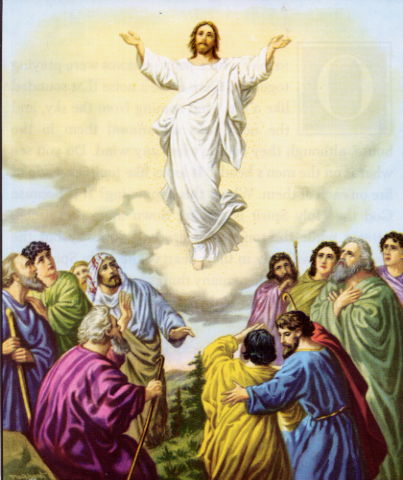
But today, Jesus just made it possible.  TO confirm this, he left them, looking up to heaven, as he was covered by  the clouds and was taken up to heaven….according to our First Reading today. This means, Jesus has completely trusted us, his Church to continue his saving mission. However, as he promised, he would not leave us orphans. And we’ll celebrate the fulfilment of this promise next Sunday, the Pentecost, when the Holy Spirit, the Spirit of Jesus comes and dwells in us, to accompany us everywhere, as we preach the Good News that God loves us unconditionally, as he revealed in Jesus, to the end to the world. By the Spirit of Jesus, he becomes present to each one of us, wherever we go, whoever we are, and whatever we do.

The Constitution on the Sacred Liturgy of the Second Vatican Council taught that Jesus is present in the Liturgy in four visible respects: in the Assembly [the body], in the Minister [the visible head], in the Word of God proclaimed, and in the Eucharistic Species of  bread and wine- which would become a real body and blood of Jesus in the Consecration. DO we really believe that the species we receive in the Holy Communion is the REAL body and Blood of Jesus? That he is really present there?

When  I was Sydney for the World Youth day in 2008, I went to this conference about the Eucharistic Miracles. The main speakers were the priest-witness of the miracle himself and the doctor [a former unbeliever, but converted later] who examined the element. The story was that this priest was giving communion one day in the Church. A lady came extended her hand, but even before the priest could place the host in her hand, she moved aside immediately. So the Host fell on the ground. Since it caught up dirt immediately, the priest took it and placed it on a glass of water, to dissolve it, for the next week or so. He put it in the tabernacle. After a week, he came to check it, but he noticed that something reddish appeared around the host. With no element of wonderment, he just left it there, thinking that it might just be part of the  process of dissolving. But the following week, he checked it again, and he found out that the host, has now become a real flesh with blood on it. He went to see doctor an expert of some kind related to human body. The priest carefully chose a doctor who don’t believe in God at all and more so with this miracle, without telling the latter where was the  specimen taken from, to avoid prejudice. The result of the examination was remarkable. First, the doctor found out that the blood is a real human blood, with all the elements on it, but he couldn’t establish the DNA. Second, the flesh was  a muscle from the innermost part of the human heart. Third,  the muscle showed that the body is a victim of a severe torture, with a prick of a thorn, from a plant that only existed long time ago inPalestine. The fourth and the most remarkable, the doctor said, that when the sample was taken from the body, the body was still alive. Hearing these, the priest was dumbfounded. The doctor asked him, where is the sample taken from. When the priest told him, it was from Sacred Host, the doctor was caught by surprised. That experience then paved the way to his conversion. And he now travels all over the world with this priest to give testimony about the real presence of Jesus  in the Eucharist.

SO this feast of the Ascension reminds us of two things: To confirm our faith in Jesus, as our Lord, the Master of all Creation, our friend, our brother, who has now in heaven to prepare our room there; and to remind us that Jesus is really present in us and with us all the time, but we have to continue proclaiming his love to all people. Through this faith in him, everything will fall into place, as Jesus’ life, death, resurrection and ascension into heaven, has revealed in us.

SO let this be our prayer.

1 Comment

Homily for the Feast of the Ascension 2011

A part of botanists were exploring almost inaccessible regions in search of new species of flowers. One day, they spied, through binoculars, a flower of great rarity and beauty. It lay in a deep ravine, with perpendicular cliffs at both sides. To reach it, someone would have to be lowered over the sheer precipice by means of a rope, and it was certainly a very dangerous undertaking.

Approaching a young lad nearby, who was watching them with great curiosity, they said, ‘We’ll give you five pounds if you’ll let us lower you down below to obtain that beautiful rare flower for us.’ The young lad took a look away down into the ravine, and replied, ‘Just a minute. I’ll be back.’ When he returned he was accompanied by an older man. Approaching one of the botanists, he said, ‘I’ll go over the cliff and get that flower for you if this man holds the rope. He’s my father.’

To trust someone is very hard to do. It is even harder when we met that person for the first time. If there is a love at first sight, there is no trust at first sight. It requires time. It requires familiarity. It requires knowing and understanding the other, to be sure, he or she is worthy of trust. Then when we think the time is ripe we would start trusting the person. And this is one of the main messages of ascension- TRUST. And here’s the rub…It’s not US who trust someone, but it is GOD himself trusting us. Can we believe this? God trusts us. God who knows who we are inside and out. God who sees us falling all the time, trusting us…

Yes, Jesus knows and sees his close friends fall short to his expectation all the time. But today’s solemnity tells us that inspite of all weaknesses, his disciples have, Jesus still trusts them… To go and make disciples of all nations, to baptize them in the name of the Trinity, in other words, in the name of Love, and to obey all that Jesus commands them to do. Yes, it is unreal but Jesus just did.

Trusting is not however, a one-sided thing. It is mutual.  SO we have in our reading today, Jesus asking his disciples to trust him as well that ‘he will be with us, always, to the end of time.’ This is quite a challenge for us because there are many instances in our lives when we just lack or even lose trust in God.

However, we just have to go on, not to remain gazing up, to heaven, sort of like wishful thinking, but to do what Jesus has entrusted to us…to proclaim his gospel to all the world. Yes, he has ascended to heaven but,  he is more real now than he was before…Before his presence was confined in a certain culture, certain group, certain time, but now, he is present everywhere.  We just have to continue looking for him here, in His  words we hear in the Mass, in the Body and Blood of the Eucharist, in the presence of people around us. He is here with us…We just have to go on, doing the mission.

We don’t have to go and preach  far off places, wherever we are, we can do it. St Paul offers us a way in our second reading today…TO Pray that everyone will come to know God who is love as was shown in the life of Jesus.

So we just trust Jesus and his words and everything will be sorted out in God’s time…