27 Comments

How to Pray with the Gospels?

Our best source of prayer will always be the New Testament. The Gospel of the Day in particular is best prayed in a  contemplative way. Here are some suggestions for this:

1. Pick a short passage from one of the Gospels and read it once.

2. Settle into a comfortable posture,conducive to peacefully listening to God.

3. Take a few minutes to relax and quiet yourself down. Relax your limbs and face muscles. Give all your cares and concerns to the Lord and let Him hold them for you, while you spend this time in prayer with Him.

4. Be aware that God fills and soaks you with his presence; that unconditionally loves you, is always conscious of you, always with you.

5. Slowly read the Gospel passage. Believe that the words are meant for you—here and now.

6.Find one of more resting places in the passage. Linger on them. Savor them.Repeat them. Reflect on them in silence. Stay with the same passage during the whole prayer period and repeat it as often as you like.

7. These five key words summarize the whole contemplative experience with Jesus in the Gospels:

Be there with Him and for Him. Yes, be there. Have you ever talked with someone who was with you bodily, but not present to you with attention and heart?

Want Him. Hunger for Him. Prepare for His coming and His word, as you would want and eagerly prepare for  a visit with the dearest person in your life. Invite Him to reveal and communicate Himself to you, to speak to you and teach you how to listen deeply to Him.

Listen to Him. Listen with faith deeply and reverently, listen with trust; listen with hunger to be fed by His word; listen with gratitude and in peace, without searching for hidden meanings. Forget about implications, applications, conclusions, resolutions, etc. Be simple, like a child nestled in his/her father’s lap, peacefully listening to his story.

Let Him. Let him what? Just let Him be with you. Let Him be Himself, how or who he wants himself to be with you. Let Him love you. Let Him speak to you. Let him hold you and console you and forgive you and strengthen you. Let Him take you through dryness and darkness, if He prefers—but let Him. What Jesus wants, Jesus deserves. Entrust yourself  to Him.

Respond to Him—in any way you want to or feel moved to respond. Be genuinely yourself and respond honestly, freely, spontaneously. Speak what is in your heart; say what you feel, even when  you feel like complaining. Remember that when you don’t know what to say, the Holy Spirit prays in you and for you. Just speaking or whispering the name of Jesus rhythmically with your breathing, or repeating words of praise and thanks are profoundly prayerful responses.

Contemplative prayer is more feeling, listening to and being aware of God and of Jesus and their Spirit, rather than saying or doing anything we do for Him. It is consciously being with Him and letting Him be for us the loving God that He is, letting Him fill us with his Spirit and letting Jesus become more and more alive and real to us.

47 Comments

A Chat with St John Baptist de La Salle

Today we are privileged to have a chat with our celebrant of the day, St John Baptist de La Salle, founder of the Brothers of Christian Schools (A.D. 1719).

JF: Oh what an honour to have you with us today St John the Baptist de la Salle. Thank you for calling in for a chat. I know that you were universally known as the Founder of the Institute of the Brothers of the Christian Schools. But do you mind telling us about your childhood, about this vocation of yours?

JB d S: Well to start with, I was born at Rheims on April 30,1651, from a good Christian family to be honest.

JF: I believe that the family  is the seedbed of vocation, is this the same in your case?

JB d S: Very much. Actually, since I was a boy, I could really feel the vocation to the priesthood.

JF: That’s amazing. What could have influenced you then?

JB d S: Due to the good instructions of my devout mother, I grew up such a pious kid, I supposed. In fact, I received the tonsure when I was only 11 years old, and then I became a member of the Cathedral chapter of Rheims at 16.

JF: Wow! That’s remarkable! Well I supposed it’s much easier in your time then, than the demands of formation now?

JB d S: Not much really. I also spent 8 years in the seminary formation. I entered the Seminary of St Sulpice in Paris in 1670, then I was ordained in 1678.

JF: But then at  that time, I  was told that you were a man of striking appearance, well connected, refined, and a good scholar. Do all these things matter to you then?

JB d S: I was looking for something more, something deeper, something meaningful. That was the content of my prayers then. And then shortly later God has answered me.

JF: In what way?
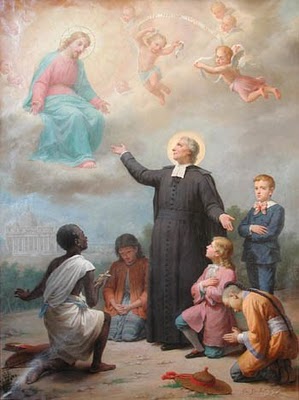
JB d S: In 1679, there was this layman named Adrian Nyel,  who came to Rheims planning to open a school for poor boys. I took up the idea, and worked with him, and we opened initially two schools.

JF: That was a quick succession of events. Did you have enough staff for your schools then?

JB d S: We had 7   masters, teaching staff  then. I personally endeavoured to  have a personal working relationship with them, to instil in them the ideals of religious education.

JF: During that time, did you not have a plan of founding an Order of your own?

JB d S: It’s tempting, to be honest. I tried prematurely once, to invite all  the masters to live with me in one home, under my supervision but, unfortunately they couldn’t take it…Five of them left at once.

JF: That’s a shame. So good you didn’t give up?

JB d S: Well God supplied the loss. After that, few men had presented themselves, and showed willingness to undergo a sort of a formation under my supervision.

JF: That’s consoling. You entertained them did you?

JB d S: Yes. I never refused God’s providence.  So I opened a house for them, in  Rue Neuve. Later on there were  requests from the outside to have school masters trained of the new method. They kept me busy…

JF: I understand. It’s always hard to start something new.

JB d S: Indeed. In fact I had to give up my being  part of a Cathedral Canon, so as to focus on the teaching vocation.

JF: Ah! So that’s why you’re able to open  four schools?

JB d S: Yes. But our main problem then was to  have the teachers properly trained.

JF: But you got over with it, I supposed?

JB d S: By the help of God, yes. I called on a conference out of my 12 men, and we came up with a provisional regulation, to take the vow of obedience, to be renewed annually, until our vocations or charism could be ascertained.

JF: And so, was that also in that Conference, when you’ve decided to take your identity as Brothers of the Christian Schools?

JB d S: True. And another thing, was that we began accepting boys aging between 15 and 20, which we never did before. You see, before that we only accepted  fully grown up men.

JF: And did you find them easy to handle or a challenge to take?

JB d S: More of a challenge actually. In 1685,  I set up a junior novitiate for them. I housed them in an adjoining house, to observe a simple rule of life. Though they were still under my supervision, I assigned  a wise brother in my newly- founded community, to oversee their training and formation.

JF: It’s not easy to train young  boys, I suppose?

JB d S: Absolutely! There were some who really need to be dealt with separately.

JF: Why do they have to be separately dealt with?

JB d S: Well, they were the young men who were sent by their parish priests to me, to  be trained as schoolmasters, and to prepare them for a teaching  job back in their own villages.

JF: And you did?

JB  d S: Ah yes! I accepted them, housed them, trained them. Thus, the first training-college for teachers was opened in Rheims in 1687, followed by Paris in 1699  and Saint-Denis in 1709.

JF: What about your poor boys in your school?

JB d S: It happened simultaneously. While the training for teachers was on  the go, the teaching of poor boys was also going on, in fact it’s going steady., but it’s only restricted at Rheims though.

JF: So you didn’t open somewhere else?

JB d S: In 1688, the parish priest of St Sulpice in Paris, requested me to take over the school in his parish, which I did. And that was the second school I established in Paris.

JF: Did you manage these schools personally or you appointed someone else to work with you?

JB d S: No, I didn’t. I assigned Brother L’ Heureux, a gifted and capable man to run  the administration of those Parish Christian Schools.  You know, I wished before that there should be a priest to take charge in every Institution of the Christian Brothers. I personally thought and commended Brother L’ Heureux to be ordained priest, but he met his untimely death.

JF: That’s tragic. So did you commend someone else then, another one from your Order?

JB d S: No more. I prayed much about it. And then I realised that it’s not God’s will to have a priest in my Order.

JF: That’s profound realization. How did you respond to it then, when obviously, you would have plenty of good candidates for the priesthood in your Order?

JB d S: I know, but we ‘ve agreed to devote ourselves strictly to teaching, as the main motivation of the Institute, and to free ourselves from ‘caste’ distinctions, we decided to remain laymen.

JF: And so is it really part of your rule then?

JB d S: Yes. It’s in our statute that No Brother of the Christian Schools should ever be a priest, and that no priest should ever become a member of the Order.

JF: As I see it, even then, you didn’t really have, as yet, a complete rule of life for your Order. Did you just figure the rules as you went along with your vocation?

J B d S: About 1695, I drafted the first matured rule somehow, including the provisions of taking life vows. I also included in there the Conduct of Schools, which sets forth the system of education to be carried out in our ministry, which revolutionized the elementary education.

JF: In what way for example?

JB d S: It replaced the old method of individual instruction by class teaching and the ‘simultaneous method’, it insisted on silence while the lessons were being given, and it taught in French and through French- not through Latin.

JF: But you opened also schools in other places aside from France did you?

JB d S: Yes, in Rome, in the early 1700’s. I sent Brother Drolin to found a school there. But mostly we just found in many places in France like, Avignon, Calais, Languedoc, Provence, Rouen, and Dijon.

JF: And what about your Novitiate house, did you transfer somewhere?

JB d S: It was providential. In 1705, it was moved to St Yon in Rouen. Together with it was a boarding school. I also established there a place for the troublesome boys, which later on became a reformatory-school.

JF: Did you still go on with your personal administration of your schools then?

JB d S: No. in 1717, I resigned. I stopped giving orders. I lived just like one of the ordinary brothers. But I still devoted some  of my times teaching the novices and the boarders. I also spent some times writing books, one of which was a method of mental prayer.

JF: I believed, you were not that old then when you resigned, what happened?

JB d S: In Lent of 1917, I suffered a good deal of asthma and rheumatism, but that did not stop me  from doing my austere habits. However, I met an accident, and that caused the weakening of my limbs.

JF: That’s unfortunate. Anyhow, you’ve left a great legacy for us in terms of Christian Education. Thank you very much. Thank you so much St John the Baptist de La Salle for your time chatting with us. Any parting words for teachers and all who looked up to you as patron?

JB d S: “You should be in no doubt that the grace which has been given you to teach children, to announce the gospel to them, and to instil in them the spirit of religion, is a great gift of God, who has called you to this holy service.”

N.B. St John the Baptist de La Salle died on Good Friday, 7 April 1719, at the age of 68. He was canonized in 1900, and in 1950 Pope Pius XII declared him the heavenly patron of all school-teachers. [Source: Butler’s Lives of Saints]

St John the Baptist de la Salle, PRAY for us.

24 Comments

Reflecting on the Gospel of John [Jn 5:1-3,5-16]

“NO man is an island,” John Dunne said. No one can live independent of anyone else. That’s why we have ears because we need to listen to other, we have eyes because we need to look at others, we have mouth because we need to talk to others, we have nose, because we need to smell the aroma of the society where we live in, we have hands to touch other people’s lives, and we have feet to go and reach out to others.

Our gospel today is a concrete testimony of this dependency. The man has been sick for 38 years, and he was there with all the other sick people. But because he could hardly move, he couldn’t get to pool ahead of the others, to be cured. He just badly needs help from the outside. And yes, he really needs help. Interestingly Jesus comes into the scene, sensing that this long-time-sick person is really needing help, and Jesus can readily offer  that help, even more. But lo, Jesus doesn’t want to intrude one’s freedom and person. So he first asked the man, “Do you want to be well again?” He reasoned out, that he’s been trying all those years to be cured, but he thought he could only do it on his own, and no one could help him, so he failed many times.

But today Jesus, helps him get up. For the sick man, NO ONE before offered to help him, but then there is SOMEONE who comes along and heals him.  So let’s only acknowledge before Jesus our helplessness and disabilities in many areas in our lives, then ask him to cure us…to let us immerse into the refreshing pool of his mercy, love, care and bounty.

24 Comments

Reflecting the gospel today…

“It’s not dying for faith that’s so hard, it’s living up to it.” William Makepeace Thackeray seems to have captured the essence of being a believer. We believe because we are alive, not dead. Belief is useless for the dead. As a believer, as Christians at that, we are called to live up with this faith, for now, and then eventually to die for this Christian faith later on.

It’s very hard to live up with our faith because  as humans as we are, we look for something tangible, something sensible, something that we can hold on to as “real”. Our faith however, is spiritual, and we could not be so certain about it, as to how much faith we really have in Jesus, the Christ, it goes beyond human measurement.

Our gospel today presents this attitude of looking for something sensible and tangible.  The official asked Jesus to come with him to his home and to cure his ailing son. But his faith has somehow convinced Jesus to do meet his need, his need of healing (of himself and of his son).

To live up with our faith is to accept that even in our deepest sorrow, God is there. To live up with our faith is to believe that even if the cloud is so thick and heavy, there is still a clear blue sky over it, and that this thick cloud will eventually pass by, and everything will be clear again.

SO let’s examine our faith in Jesus today. Do we really believe that Jesus can do something for us, in us and through us, in spite of our littleness, unworthiness, or selfishness at times?