 In previous weeks I’ve pointed out that most of the Christians of Ephesus would have come to the faith from pagan backgrounds. Different peoples had different gods and different beliefs. In the
 The Good news in the Gospel
Homily for 17th Sunday in Ordinary time 2012, Year B
 Our Gospel today is really a Good News for all of us for many reasons.
-
The first good news is that we are God’s priority. We remember last week’s gospel, Jesus was wanting to have time with his disciples alone after their first missionary experience, but due to the big crowd following them, whom Jesus felt like they are sheep without a shepherd, Jesus had to forgo his own needs and tended to the needs of the people. In our gospel today, we have Jesus feeding the crowd of five thousand men and women and children out of few loaves and few fish.
-
The second good news for us today is that God’s goodness and grace is so abundant that there is always extra or leftovers even after we had our fill. We can hear this from the stories of people who are giving so much of what they have and never went broke. I don’t want to brag about myself, but I can attest to this. I give what I can, and God just compensates everything I gave away and sometimes even he doubles the compensation. Because God loves a cheerful giver (2 Corinthians 9:7).
-
The third good news from the gospel today is that we don’t have to be great or popular or rich for God to use us as his living instruments and signs of his love and care for us all. We don’t even have to have a name to be able to share what we have. The boy in our gospel today has no name. We can call him ‘barley lad’ maybe, or ‘fishy fellow’ but it doesn’t matter for Jesus. We may not remember who he is, but he will be always remembered by what he does. He gave up the little provision he had to Jesus and that made so much difference. It was able to feed thousands, and plenty of leftovers. The man in our First reading today has no name too, but his little gift of twenty barley loaves to Elisha, was able to feed a hundred men. If we focus more on our personal gain when we give, we can’t go without ringing TV crews or Media personalities to record everything we’ve done. But our gospel today reminds us that it is in and through our littleness or nothingness that God’s love and concern for us is more evident and more effective.
-
The fourth good news for us today is that Jesus did not just feed us once or twice or thrice, but always. We know this because we are taking his body and blood as our food and drink every time we celebrate the Eucharist. Yes, it is in the Eucharist that we realise Jesus always feeding us not only with his living Word but more so of his body and blood to nourish us and to sustain us as we journey towards eternal life. And the amazing thing is every time we celebrate the Eucharist, we are witnessing a great miracle. We are partaking in the great sacrifice of Christ on the Cross. In the Eucharist we personally become part of the drama of our salvation. Through holy communion, we are receiving the real and living body and blood of our Saviour. This reality enables St John Vianney to say: ‘If we could comprehend all the good things contained in Holy Communion, nothing more would be wanting to content the heart of humankind. The miser or the miserable would run no more after his treasures, or the ambitious after glory; each would shake off the dust of the earth, leave the world, and fly away towards heaven,”
Such is the beauty of holy mass and holy communion that Padre Pio also exclaims: ‘The world could survive without the Sun but not without Holy Mass.’
So we must remember always in the Eucharist, we experience the utmost generosity of our God, in a real and personal way. I would also leave you with the words of St Francis de Sales:
“When you have received Him, stir up your heart to do Him homage; speak to Him about your spiritual life, gazing upon Him in your soul where He is present for your happiness; welcome Him as warmly as possible, and behave outwardly in such a way that your actions may give proof to all of His Presence.”
So, as we continue our Eucharistic celebration, let us thank the Lord for making us his priority and for giving us himself to be our food and drink. At the same time, let’s pray that we no longer lament on our being small, having very little, or being insignificant because in the eyes of God, everyone is someone. We can do this with Jesus and by listening to St Paul in our Second Reading today to live our lives according to the vocation that God is calling us to live. By doing this, we become good news to other people. Amen.
Sharing our littleness: A Big thing
Homily for 17th Sunday in Ordinary time Year B 29 July, 2012
 Three years ago, I witnessed a miracle myself and until now I couldn’t stop thanking God for his wonderful manifestation of his compassion to me and to my family. Three years ago, my 14-year old nephew was diagnosed with Leukaemia. His case was already the worst. My family and his (my nephew’s) parents began to lose hope that he would recover. He could no longer walk because his knees and elbows were swollen and it caused him pain day and night. We wanted to hospitalize him but we don’t have hundreds of thousands to pay for it.
At that time, I was assigned at St Kilians Parish for my Pastoral placement. Towards the end of my placement, I indicated to one person in the parish my wish, my hope and my prayer that I can find a way to help my nephew. I was hoping then even just to provide him a wheelchair, at least to ease up his suffering for the last days of his life, so we thought.
Unbeknown to me words of my hopes, wishes and prayers for nephew was passed on to few of the parishioners. The parish organized a leaving collection for my nephew at the very last day of my stay in the parish. It was an unreal and such a moving experience for me. Many who came to that Sunday Mass had fished some change in their pockets and purses, from the little they can have to the most they can give. The total amount I received was unbelievable. I can’t believe just by simply asking for a simple wheelchair, I got the amount that was even more than what my nephew immediately needs for his hospitalization. I rang home that day, and urged them to take my nephew to the hospital at once which they did. However, he was turned down by two private hospitals because even the doctors there had very little or had even lose hope that he would recover. They were concerned we might just be wasting so much money.
Amazingly, he was admitted to the third hospital, treated immediately, and went out of the hospital a week later. He had recovered quite well, no chemotheraphy or radiation, just a monthly check-up. And the other amazing thing is there is a wonderful parishioner of St Kilians who is faithfully and continuously sponsoring my nephew for his monthly check-up, for more than three years now. This all happens just because of my simple hope for a wheelchair, heard by God, and had encouraged everyone who heard it to share what they had. This experience teaches me that no matter how little we can give if given in love and shared with the community, God makes a great miracle out of it.
This is what the little boy in our gospel today does. He gave up the little provision he had (5 barley loaves [usual food for the poor] and two fish) to Jesus. No mention of his name there, in a way he is just nothing, he is just one of the crowd. But out of his nothingness, out of the little thing he had, Jesus was able to feed thousands and even collected 12 baskets of leftovers.
The same thing happened in our First Reading today. A man, again an unnamed person giving a gift of food to Elisha. He had given twenty barley loaves maybe just intended for Elisha’s consumption. But Elisha asked to share it with a hundred men. A miracle happened. All had their fill and even there were some leftovers.
This teaches us therefore that what matters the most is not on what have we given, or who are we who gives but on how united are we in our cause of generosity and in how much love do we give in our act of giving. Love therefore must be the motivation behind everything that we do to our Lord and God and to our neighbours. It must be love and only love that motivates us to be true to ourselves before God and before others. If love is what energises and empowers us, we come to realize that we don’t really have to be rich in order to do something great. We don’t have to be famous, and popular in order to give. And as our Gospel and First Reading today would tell us, we don’t really have to stand out of the crowd, or to be the centre of attention in order for God to do something great in and through us. We just have to act together in love and something amazing will happen.
How can we tell if our act of giving is inspired by love or by personal glory? St Paul in our Second Reading today, somewhat offers us few ways to review our life in the way we give to others. St Paul wrote to the Ephesians: ‘Lead a life worthy of your vocation. Bear with one another charitably, in complete selflessness, gentleness and patience…(Eph 4:1-6). Do we really give for the sake of the other person’s needs or only because we are hoping to get something in return?
Our celebration of the Eucharist opens for us another way to see if our giving is motivated by love or for our personal gain. Every time we celebrate the mass, we are witnessing the sacrifice of Christ on the Cross in Calvary. Every time we attend Holy Mass, we are partaking the great and singular sacrifice of Christ who is so in love with us, so much so that he laid down his very life for all of us, his beloved. God loved us so much that he gave up his only Son. Christ loved us so much that he gave up his own life for us his friends. Christ gives his life for us totally, unconditionally, no strings attached, just for our salvation.
A concrete proof of this selfless love of Christ is his utmost generosity of himself by becoming our real food and drink in the Eucharist. Because of his love, God great as he is, allowed himself to be contained in that simple and small earthly elements, to become our nourishment. He became little and small, for us to grow and be prepared for the coming of the Kingdom. So if like Jesus, we don’t hesitate to lay down our lives for others then, this is selfless love and surely not for personal gain.
Yet as we now realize, with God our littleness and our nothingness if you like, is always something for God, and he can always make a miracle out of it. So let’s stop accusing ourselves or blaming ourselves, or let’s stop the habit of self-pity and despair, because we have God who cares for us so intimately and personally (by being our food and drink in the Eucharist). So let’s instead continue or develop the habit of thanking God for his great love for us.
I would leave you with the words of St John Vianney on the beauty of holy Communion, the moment in the Mass where we experience the personal and the intimate touch of Christ in us and the greatest miracle we can witness and even participate in today. The Saint said:
“If we could comprehend all the good things contained in Holy Communion, nothing more would be wanting to content the heart of man. The miser would run no more after his treasures, or the ambitious after glory; each would shake off the dust of the earth, leave the world, and fly away towards heaven,”
Because of the beauty of holy Communion, St Francis de Sales also urges us to pay so much care and attention to our Lord every we receive him in Communion. St Francis wrote:
“When you have received Him, stir up your heart to do Him homage; speak to Him about your spiritual life, gazing upon Him in your soul where He is present for your happiness; welcome Him as warmly as possible, and behave outwardly in such a way that your actions may give proof to all of His Presence.”
A balanced leader…
Homily for 16th Sunday in Ordinary time year B 22 July 2012
-
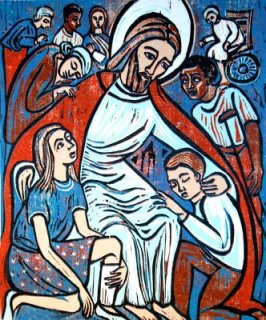 I always cringe everytime I see or hear leaders in the country, in a parliamentary session just throwing mud at each other. It always leaves me discomfort and sometimes even upset when I can sense that these leaders whom the general public voted for the office, keep their focus more on self-preservation rather than on the immediate needs of the people they governed. There are people dying out there, there are people being discriminated against, there are people being bullied, etc., but they would want to keep their reputation impeccable first rather than doing something about the many social concerns that need special care and consideration. Yes, self-preservation is necessary, in fact very important. This is why we have the common cliché ‘survival of the fittest.’ But for God’s sake, leaders are made so because of the people they are to lead, so in a way by assuming the responsibility of being a leader, they or we should know and understand how to make a balance out of who we are, what we need and what we are to do.
 -
Jesus in our gospel today tells us a how to balance our lives amidst the many things and concerns we may have. Last week, he sent his apostles in two’s for a mission, now they come back bringing with them all the beautiful experiences they have had while doing the mission. They seem to be very excited to report back to Jesus about everything, More so, people couldn’t stop coming to them. So Jesus urged the apostles to go and have a rest in an isolated place, to do a retreat in a way. Off they went. But the people followed them , because they could guess where they were heading to. Jesus allowed his disciples to rest while he taught the people who followed them. When he saw them, he was moved with pity and compassion because they are like sheep without shepherd. As a shepherd, he couldn’t turn them away. He would have wanted to have a quiet time with his apostles, but because of the immediate need of the people, he had to forego his own whims and desire. The feeling of pity and the compassion that Jesus felt towards the people is much more than just a mere human feeling or emotion. He pities them not because of the sight of their misery and misfortune but because it arouses such a deep feeling in Jesus that impels him to do everything possible to relieve the sufferers by a total commitment of himself to them and to their needs. In this way Jesus is showing us an example of how to be a good leader. ‘There is nothing which provides better instruction for others unto piety and worship of God’, says the Council of Trent, ‘than the life and example of those who have dedicated themselves to the divine ministry.’
-
This is the kind of a Shepherd that God wishes to every appointed leader in the land- a leader who knows that he or she needs to go alone every now and then, and reflect on his or her life before God and on what she or he is doing, but also at the same time not forgetting the needs of the people whom he or she is sent to. A shepherd is one who knows the balance between self-preservation and ministry.
-
This is in contrast with what a slack shepherd is as our First Reading today tells us. The Prophet Jeremiah tells us that a shepherd who allows the flock to be destroyed and scattered is repugnant for the Lord. The shepherd who just preserves him/ herself is one who just allowed the sheep to go wandering and have not taken care of them. And we know there are leaders like this today in our world. We have leaders who couldn’t support the general move to assist a certain country in violence and war, maybe because of their connection or debt of gratitude to the reigning tyrant. We have leaders who couldn’t make one common solution to a prevailing problem of people smuggling. We have leaders who are still engrossed with the idea of self-preservation over leadership, by stealing the people’s money in corruption, lying and overpricing projects, etc.
-
Knowing this, we need not just a shepherd, but a good one. And there is only one Good Shepherd, Jesus Christ. We need him more than ever, because he alone can break the barrier between peace and war, between selfishness and generosity, between love and hatred. Let’s allow Him to work in us and through us. We are his hands and feet now, we are his mouth and ears now, we are his body, so let’s fulfil our particular mission in the flock of God for the whole flock.
-
So as we continue our celebration of the Eucharist today, let this be our prayer: that the Spirit of Jesus Christ, our Good Shepherd would come and fill those who are appointed leaders in our land, so that we may be faithful to what we are called for and to whom we are called to serve. Amen.
 Junjun FAITHBOOK