3 Comments

The EUCHARISTIC SPECIES: The REAL body and blood of Jesus Christ

THIS IS POWERFUL!!!!! PLEASE TAKE THE TIME TO READ IT AND PASS IT ON  TO OTHERS.
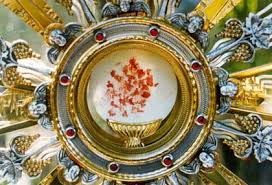
Dear friends this is a homily given by Father Jeffrey Montz, distributed by his friend. This is a very moving reflection on how real the body and the blood of Jesus that we always receive in the celebration of the Holy Mass

Here is Fr. Jeff’s Homily:

I am the bread of life. In the year 2009, I was distributing communion to the faithful when a young woman approached and extended her hands to receive the Eucharist. Almost as soon as I had placed the Host in her hands, she began moving away and in the process she dropped the host. Standing over the fallen Host lying on the ground, a slight giggle, shrug of the shoulders, and re-extended hands, her body language said to me, ‘Ooops, I dropped it. Can you give me another one?

I am the living bread that came down from heaven; whoever eats this bread will live forever; and the bread that I will give is my flesh for the life of the world.

August 15, 1996 an elderly Eucharistic minister was distributing the Precious Body of Christ to the faithful in a parish in Buenos Aires , Argentina when a similar accident occurred. Not wanting to consume the Host because it was dirty after falling to the ground, he asked the priest to pick it up. Reverently the priest placed the Host in a receptacle of water and put it into the Tabernacle where it would dissolve with time. Six days later when the priest examined the Host that should have been dissolved by now, he was perplexed by what he saw. The Eucharist seemed to have grown in size and was covered with red splotches. 

Leave it for a few more days, he thought; it’s just a matter of time. But then with each passing day the Sacred Species took on the appearance of coagulated blood, until eventually the Host looked like a piece of flesh. The bread that I will give is my flesh. A miracle! Perhaps, but first this had to be investigated. A lab in Buenos Aires examined a sample from the Host. The scientist discovered red blood cells, white blood cells, and hemoglobin, but what perplexed him the most was that the cells were moving and beating. 

Three years later Dr. Ricardo Gomez was called in to perform a more thorough examination. He sent a sample from the Host to a lab in New York but didn’t tell them what it is; he wanted them to tell him what it is. They did. It’s a  living muscle from a human heart.

Now the year is 2004, Dr. Gomez had located a unique doctor named Frederick Zugibe whose expertise in examining the heart of a dead person allows him to know the nature of the person’s death. He too was given an opportunity to examine the Host without knowing that this heart was formerly a round wafer of wheat bread. His findings? 

The heart belonged to a person who had been severely tortured. So Pilate wishing to satisfy the crowd, released Barabbas and after flogging Jesus, he handed him over to be crucified. 

After his examination, Dr. Zugibe passionately said to Dr. Gomez, You have to explain one thing to me, if this sample came from a person who was dead, then how could it be that as I was examining it the cells of the sample were moving and beating? If this heart comes from someone who died in 1996, how can it still be alive? When Dr. Gomez explained to Dr. Zugibe that it was the Eucharist, he nearly pulled his hair out of his head in shock. 

Backtrack to the 8th Century in Lanciano, a town in southern Italy where a priest was celebrating the Mass doubting that Jesus is truly present in the Eucharist. As he raised the Host, it instantly transformed into a piece of flesh in his hands. In the 1970’s this piece of flesh, which remains available for veneration to this day, was tested by a leading Italian doctor. His findings? It is living muscle from a human heart. Dr. Gomez decided to cross examine the Host from Buenos Aires with this Host from Lanciano.

Amazingly, both hearts were found to have come from the same person. I am the living bread that came down from heaven; whoever eats this bread will live forever; and the bread that I will give is my flesh for the life of the world. My brothers and sisters, our faith proclaims to us the wondrous mystery that Jesus Christ is truly, really, and substantially present in the Eucharist, the Bread of Life. It’s no mere symbol, no mere reenactment. It is the Precious Body, Blood, Soul, and Divinity of Jesus Christ! What I place in your hand or upon your tongue is not a ritual piece of bread. I place God in your hand! I place God on your tongue! 

I know that even after telling you the story of the Eucharistic miracle in Buenos Aires , I haven’t proven this. I can never prove this truth, because it’s a matter of faith. However, all I’m asking my brothers and sisters is that you ponder the story I shared with you this morning. 

Perhaps, the skeptic in you calls it all a bunch of lies. Perhaps, the unimpressed call it a coincidence.  

Perhaps you’re a person of faith and you’re in awe at what I’ve shared with you. All I ask is that if there’s the slightest inkling in your hearts that what you receive in the Eucharist is the flesh of God, then please my brothers and sisters, never let the lance that pierced my heart in 2009 when that young woman stood carelessly over God’s fallen Body pierce my heart again. Please treat this mystery which you receive with the reverence God deserves. 

HERE IS FR. JEFF’S RESPONSE TO ME WHEN I ASKED PERMISSION TO PASS HIS HOMILY ON TO YOU. Hey, I’ve heard it said that in any good homily we’re really preaching to ourselves. That being said, as familiar as I was with the homily before I delivered it, I found that in delivering it to the people it still had an effect upon my heart. For lack of better words it stirred me. Afterwards, I found that my celebration of the Eucharistic Prayer was even more meaningful. I can’t express how moved my heart was as I said those words, “This is my body.” Those words seemed to flow from my heart as if they were flowing directly from the Heart of Christ. The tone of those words almost became a tone of pleading on Jesus’ part, “This is my body,” “please believe me; this IS my body and I want all of you to believe and to receive my Heart of Love!” We are so blessed to have the Eucharist!!! Anyways, I’d be happy if you should share this homily with others; these are the miraculous stories that God wants us to share so that our faith can be strengthened. As it says in the Scriptures, “Encourage one another while it is still day.” It’s sort of like the Transfiguration which was revealed to Peter, James, and John so that they could persevere through the Passion and death of Jesus. And I wouldn’t even mind if you didn’t give me credit. After all, it is God who deserves all the credit on this one; I just did the typing. Blessed be the Name of the Lord now and forever!


Leave a comment

Are you saved? Then Look like ONE….

A man dived into a raging swollen river to rescue a boy who had fallen in. It was a tough struggle. The river was in full spate, and it was a miracle of God that the man succeeded in grabbing an over-hanging branch, while clinging to the boy with the other hand.He brought the boy to safety, none the worse for his near brush with death. He brought him home, and gave him over to the care of his mother. As the man was leaving, the boy said, ‘Thank you very much, sir, for saving my life.’ The man put one hand under the boy’s chin, and looked him in the eye, and said, ‘That’s OK son! Just make sure your life was worth saving.’ [j.mcardle]

Jesus would also remind us now with these or similar words, to acknowledge the value of our life. Each one of us is unique and special in the eyes of God. Just imagine this, on the sixth day, God made us human beings, man and woman. Then after creating us, he just loved us so much that he couldn’t help but enjoy looking at us, that he didn’t create anymore after us.

There’s no point imitating those people whom we think our model in life. God wants us to be ourselves. Jesus asks us to love God and our neighbors, as we love ourselves. But how can we love ourselves when we don’t even know our real selves? How can we face our true selves, when we are living in fantasy, of what we want ourselves to be?  God has already done in us, what we are supposed to be…and that is to be loved. And proof to this love is his death on the cross to save us from death in sin, and to give us life…life to the full…the fullness which  can only be found in God.

SO: “If we are saved, we should look saved, and live like people who are saved.” [j.m.]

Leave a comment

Feast of the Visitation of the Blessed Virgin Mary: A foretaste of Heaven

The celebration of the Holy Eucharist today in our Diocesan Seminary here in Melbourne Australia is one of those events that enabled me to have a foretaste of heaven. Truly, every Celebration of the Eucharist is a sharing of the eternal sacrifice in heaven, but today’s Mass confirms it even more. There were nine priests, with a Vietnamese born priest presiding and the concelebrants consist of Australians, Indian and Nigerian. This has even confirmed more by the composition of the congregation. There are over 50 seminarians here as of the moment, representing many countries and continents even. We have Australians, Filipinos, Vietnamese, Sudanese, Nigerian, Italian, Croatian, Indian, Korean, New Zealander, Maltese and Scottish background. Reflecting on this, I felt so privileged to have this foretaste not only of what  a Catholic Church really is like,i.e. universal, but also because it has enabled me to have a glimpse of heaven. Heaven is real and it is something I am looking forward to it. Thus, I am one with Mary today in singing “My Soul glorifies the Lord, for he has done great things for me.”

Here is the homily given by Fr Binh Le, the Vocation Director of the Archdiocese of Melbourne, for this feast of the Visitation.

Today, we celebrate the feast of the Visitation, also known to us as the second joyful mystery of the Rosary. The visit of Mary to Elizabeth is not just an ordinary and simple visit between relatives but of  two people graced by God in different ways and both are bringing Scripture to fulfillment. Elisabeth is bringing forth John the Baptist, the herald of Christ to Judaism, and Mary will give birth to Jesus, the Saviour of the world.

The Visitation of Mary to Elizabeth is more than a simple  visit. We were told that Mary stayed with  Elisabeth for three months to help her during her pregnancy. Let us reflect briefly on that little detail of three months, which today’s gospel omitted. 

There are many paintings and sketches of the Visitation scene which only detail the initial encounter of Mary’s visit to Elizabeth. Yet, there are no paintings or sketches of Mary during those three months. She was evidently doing the work, making the meals, keeping things in order; Mary was constantly working behind the scenes.And those three months showed Mary to be a true handmaid of the Lord.

One test of our spirituality is what we do when nobody is watching, when the cameras are turned off and when we don’t feel inspired and motivated. Are we as faithful in private as are we in public? Mary was. The Visitation of Mary to Elizabeth highlights Mary’s virtues of charity and humility.

Mary is still helping people behind the scenes in so many ways today. Mary Continues to assist and intercede not only in such  well-publicized shrines such as Fatima or Lourdes but also in many ways that will never be known to most of us. I am sure that every parish has people who can recount interventions by Mary, some spectacular and others less so, where Mary’s prayer and intercession became a decisive part of their lives.

In this mystery of the Visitation, we see Mary as a model of genuine care, of quietly and joyfully serving the Lord through others, a model of persistent and hopefulness when facing with difficulties, a model of kindness, of charity and of humility. She is a model for genuine spiritual life which St Paul describes in today’s first reading. And that is why Elizabeth described Mary as ‘the most blessed” of all women.

Today’s feast of the Visitation invites us to seek the grace and the virtue of quiet and joyful service of the Lord through others, which is the real measure of our fidelity to Christ [and] or our growth in maturity of our formation in the seminary.

Leave a comment

Flores de Mayo in the Philippines

The whole month of May is dedicated to Mary in the Philippines. This is the time when kids, who are in their school holidays are taught Catechism in their own parishes, while some of them are preparing for their first confession and communion. This is also the month when the Santacruzan is held, when ladies would put on their best gowns as they portray the different gifts of the Holy Spirit and some other elements of the Catholic Faith. The highlight of this Santacruzan is the Reyna Helena and her Son Constantine. But all of these are all Spanish influences to us. 

There is however,  uniquely Filipino in this tradition. We call it the FLORES de MAYO (translated FLOWERS of MAY). It is said that it originated in Malolos Bulacan. It is so because it is in this month that the flowers would blossom on  their best, for the typhoons or storms are quite minimal at this month. So, the kids, would pick the flowers, offer it to Mary, to thank her  for interceding for us for the good weather and for the blossoms. Thus, came the term “FLORES de MAYO.” This has been a practice among Filipinos for sometimes now. Not only the children but all sorts of people would come to the Church, even everyday for the whole month of May, to pray the rosary and to offer flowers to our Lady. We don’t worship  Mary as our God as  some Christian groups accused us, but we look at her as our model of faith. We venerate her because “many Filipino Catholics learn more about the faith from their devotion to the Virgin Mary than in any other way.” (Catechism for Filipino Catholics 155). Thus, we all have many images of Mary…Just take  a moment to look at this…

This song is pleading Mary, our Mother to bring us closer to her Son, our brother….